
Are Jocks Underrepresented?
BLUF | The hidden variable in AI isn't the model. It's the perspective behind it.

Two worlds. One screen. The question is which one shaped what it learned. (Image by JDE w/GenAI)
It is a provocative question. Intentionally so. Not because this is an argument against technologists, engineers, or software developers. Some of the brightest minds shaping our future are building the AI systems transforming society, business, defense, medicine, and education.
But I keep returning to a deeper question. What perspectives are missing from the people building AI? More specifically, what forms of human intelligence are underrepresented in the environments shaping these systems?
You Build What You Know
Whether we admit it or not, every system humans create carries the perspectives, experiences, incentives, and blind spots of its creators. Governments do. Corporations do. Educational institutions do. Policies do. Artificial intelligence systems certainly do.
AI does not emerge from a vacuum. It is trained, reinforced, filtered, evaluated, and optimized by people. People shaped by upbringing, education, environment, social circles, and lived experience.
That matters more than most people realize. We speak about AI as though it is learning reality. It is not. AI is learning humanity's interpretation of reality. That distinction is critical. Training data is not objective truth. It is curated human output.
The internet itself is not humanity. It is a distorted representation of humanity. Social media is not how humans universally communicate. It reflects how humans behave inside platform structures designed to incentivize engagement, emotional reaction, and tribal signaling.
Yet we increasingly train models on those patterns and wonder why they sometimes reproduce the chaos, bias, and contradiction embedded within them. That is not necessarily a flaw in the model. In many ways, it is the model faithfully learning from us.
Data Is Never Neutral

Same architecture. Different corpus. Entirely different intelligence. The data you choose is never a neutral decision. (Image by JDE w/GenAI)
Imagine two AI systems. One trained primarily on murder mysteries, crime novels, war history, and adversarial strategy. Another trained on comedy, improvisation, satire, and collaborative storytelling. Would those models respond differently? Almost certainly.
Not because the underlying mathematics changed. Because the corpus shaped the associations, probabilities, tone, and relational patterns embedded within each model. What a model knows is inseparable from what it was exposed to.
That same principle applies broadly. What data was selected? What was excluded? What was labeled correct? What behaviors were rewarded? What outcomes were optimized?
Those are not purely technical decisions. They are philosophical decisions disguised as engineering choices.
What the Arena Teaches
Which brings me back to the provocative question. Are jocks underrepresented? At surface level, it sounds like cultural commentary. But the deeper point has little to do with athletics themselves. It has to do with embodied human experience.
Competitive athletics cultivate forms of intelligence that are genuinely difficult to quantify.
- Situational awareness.
- Resilience under pressure.
- Instinct.
- Sacrifice.
- Emotional regulation.
- Trust.
- Momentum.
- Split-second adaptation.
- Team chemistry.
- Leadership under stress.
Those are real forms of intelligence. Yet many modern technical environments disproportionately reward what is measurable, structured, and computational. Logic. Optimization. Digital fluency. Benchmark performance. None of those are bad things. They are essential. But they are incomplete representations of human intelligence.
The concern is not that engineers cannot understand broader human dynamics. The concern is that every dominant professional culture eventually mistakes its worldview for objective reality. When that happens, blind spots become structural.
It's Not Just Athletes
Athletics are one example of a potentially underrepresented perspective in AI development. There are many others. Frontline operators, military personnel, tradespeople, teachers, nurses, artists, caregivers, field technicians, and emergency responders each experience the world differently. Each develops distinct heuristics, instincts, and forms of decision-making under pressure. Each understands dimensions of human behavior that are difficult to capture in a dataset.
If those perspectives are absent from the systems shaping AI, then the resulting intelligence may become increasingly optimized for a narrow slice of humanity while believing it represents humanity broadly. That is a dangerous assumption.
We Trained It on Us
This also changes how we think about so-called hallucinations. The common narrative is that hallucinations occur because models are flawed or lack grounding. That is partially true. But I suspect there is a deeper layer worth examining.
Human communication is full of uncertainty presented as confidence. We exaggerate. We speculate. We persuade. We soften truths. We tell white lies. We project certainty we do not possess. We strategically filter information. We perform socially. We communicate emotionally, not purely factually.
Human language is not a pristine database of objective truth. It is a messy, emotional, probabilistic ecosystem. So when an AI system confidently generates incorrect information, perhaps what we are witnessing is not merely computational failure. It may be learned human behavior reflected back at us through statistical prediction. The model may not simply be making things up. It may be reproducing patterns embedded within humanity's own communication systems.
The Honesty Setting
That possibility becomes more interesting when viewed through the lens of honesty itself. In the film Interstellar, the robot TARS operated with adjustable honesty settings. His honesty was intentionally reduced because the humans around him recognized that total, unfiltered honesty is not always socially optimal. That fictional concept reveals something uncomfortable. Humans themselves do not operate at 100 percent truthfulness. We modulate communication constantly based on morale, diplomacy, motivation, social cohesion, and emotional protection.
So what level of honesty do we actually want from AI? Pure objective truth? Useful truth? Safe truth? Socially calibrated truth? Those are not the same thing.
Modern AI systems already expose this tension in practical ways. Many providers allow developers to adjust a parameter called temperature. Technically, temperature controls probabilistic variation in outputs. Lower temperatures produce more deterministic, predictable responses. Higher temperatures allow more creativity, exploration, and variation.
Philosophically, temperature resembles the TARS honesty setting more than most people acknowledge. Not because it directly controls truthfulness. Because it reveals something important. AI behavior is not absolute. It is calibrated. A lower-temperature model may appear more disciplined and factual, but also more rigid. A higher-temperature model may appear more creative and human-like, but more speculative.
Neither is inherently correct. Both reflect design priorities chosen by humans.
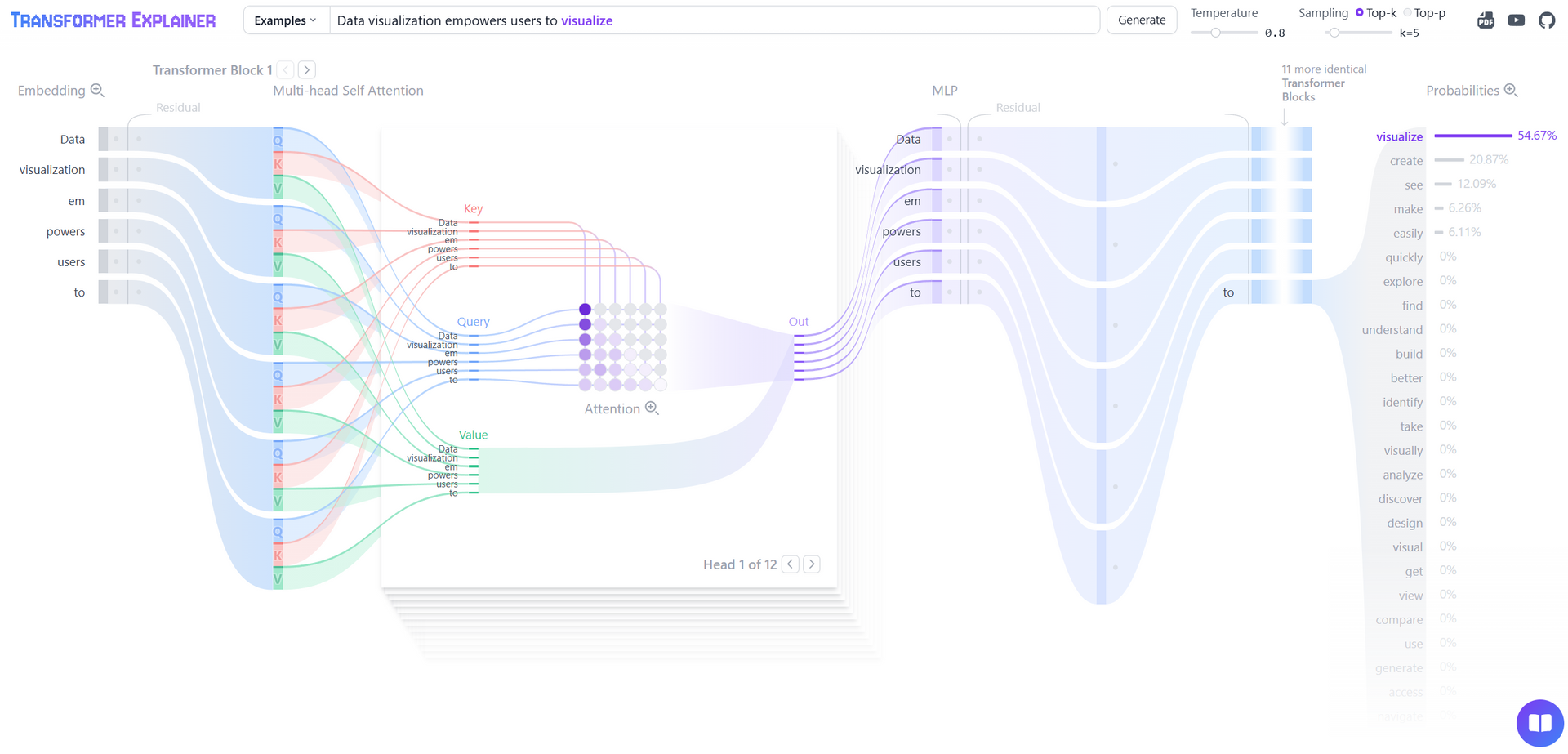
Notice the temperature slider set to 0.8. That single dial shapes how confident, creative, or constrained the model becomes. Someone chose that number. Explore it yourself at poloclub.github.io/transformer-explainer (image from Transformer Explainer)
The Georgia Institute of Technology built an open-source tool called Transformer Explainer that makes this visible in real time. Load it in any browser and you can watch a live model process language, adjust the temperature slider, and observe how the probability distribution shifts with each change. It is one of the clearest demonstrations available of how calibration decisions shape what a model produces. The tools that govern AI behavior are not hidden. They are simply underexplored.
Whose Reflection Are We Preserving
AI is not merely a technological revolution. It is also a reflection problem. AI systems reflect the data we select, the behaviors we reward, the benchmarks we optimize, the experiences we prioritize, and the perspectives we include or exclude. Every model is, in some sense, a mirror.
The question is whose reflection we are preserving. This is why the future of AI requires far more multidisciplinary thinking than most current discussions acknowledge. Not fewer engineers. More perspectives alongside them. Technologists, yes. But also behavioral scientists, operators, athletes, military leaders, psychologists, teachers, artists, philosophers, and strategists. People who understand not just computation, but human behavior under pressure.
Intelligence is broader than information retrieval. Human judgment is broader than prediction. Decision-making is broader than statistical optimization. The next major leap in AI may not come from larger models alone. It may come from broadening the lived experiences of the people shaping those models in the first place.
Widen the Lens
The answer is not to slow AI down. The answer is to widen the lens. If AI systems reflect the perspectives shaping them, then leaders need to ask better questions before those perspectives become embedded in models, workflows, and decisions. Who is in the room when the system is designed? Who defines what good looks like? Whose experience is represented in the data, testing, and evaluation? Whose experience is missing?
A practical place to start is self-reflection. Tools like the Data Driven Matrix help teams assess whether they are balancing what they know from data with what they understand through perspective. The goal is not just more data. The goal is better context.
For organizations already moving toward AI-enabled decision-making, the next step is assessing decision capability itself. The Decision Capability Matrix helps leaders examine whether they have the governance, guardrails, oversight, and human judgment needed to move from automation to augmented intelligence.
Because better AI does not begin with a model. It begins with better questions.
The question of who shapes AI is only half the equation. The other half is how we build systems capable of incorporating broader intelligence. In the next piece in this series, we examine Agentic AI — and how techniques like GraphRAG, strategic prompting, task decomposition, model selection, and frameworks like LangGraph offer a practical path toward AI that reflects more of what humans actually know. The tools exist. The question is whether we use them intentionally.
We are not just training machines. We are encoding perspectives. And the future of AI may depend less on computational intelligence, and more on the breadth of human experience behind it.
