
Compressing Learning Time: How Leaders Turn AI into an Advantage
BLUF | We gain time, clarity, and capability when we treat generative AI as a learning superpower instead of another tool.
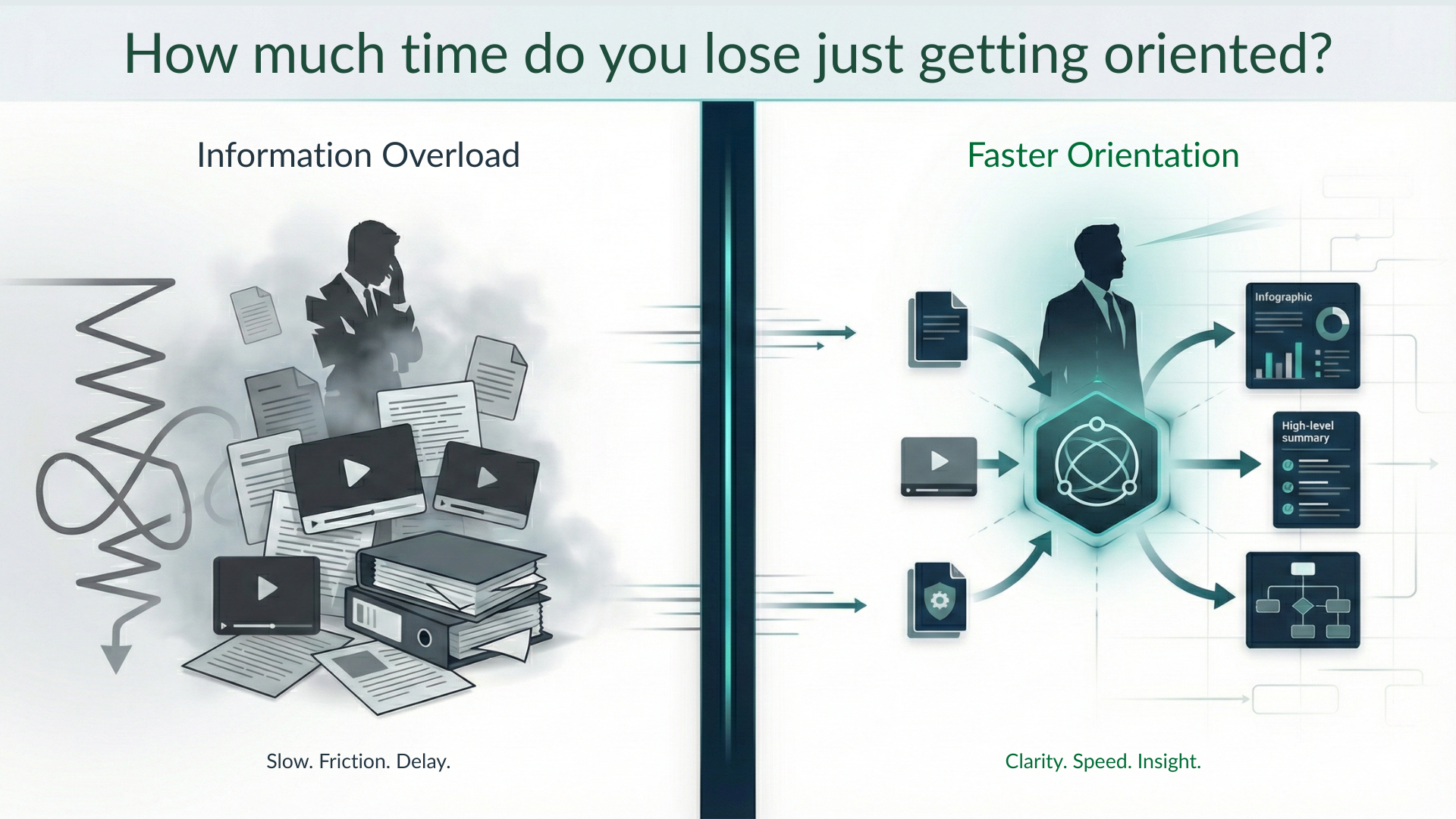
Have you ever had to brief a senior leader on a complex problem but spent most of your time just orienting them to the landscape? Or maybe you've been the leader walking into a meeting and needed to get smart fast before you enter the room. No time to read it all. No space to absorb it. You just need the picture.
A simple visual can change that. A clean infographic can compress the learning curve in seconds. Research backs this up: hear a piece of information, and three days later you'll remember 10% of it. Add a picture and you'll remember 65%.¹ Generative AI now gives every leader the ability to create these visuals on demand. Not as a replacement for required reading. Not as a shortcut around accountability. But as a fast 10 to 20 percent head start. A starter pistol. A way to see the terrain before you move through it.
AI as a learning superpower
Most leaders don't struggle with information scarcity. They struggle with absorption. New software. New policy. New mission requirement. The learning curve expands. The available hours shrink.
AI doesn't replace learning. It removes the drag. It accelerates the slowest part of the process: orientation. That shift is the superpower.
But expectations matter. AI won't give you mastery. It gives you 10 to 20 percent. Just enough to see the shape of the problem. Just enough to build a 35,000-foot view in ten seconds. You still need to read the policy. You still need to make the decision. But you start with context instead of confusion. That saves hours. Across a workforce, it saves months.
NotebookLM is one example of this pattern. Not the only one. But clear enough to make the capability real.
A practical workflow for learning at speed
I needed to understand Tableau Next fast. Instead of consuming ten videos end-to-end, I uploaded them into NotebookLM. It highlighted the shift toward agentic workflows and a unified workspace. It framed the evolution in a way that matched how I learn.
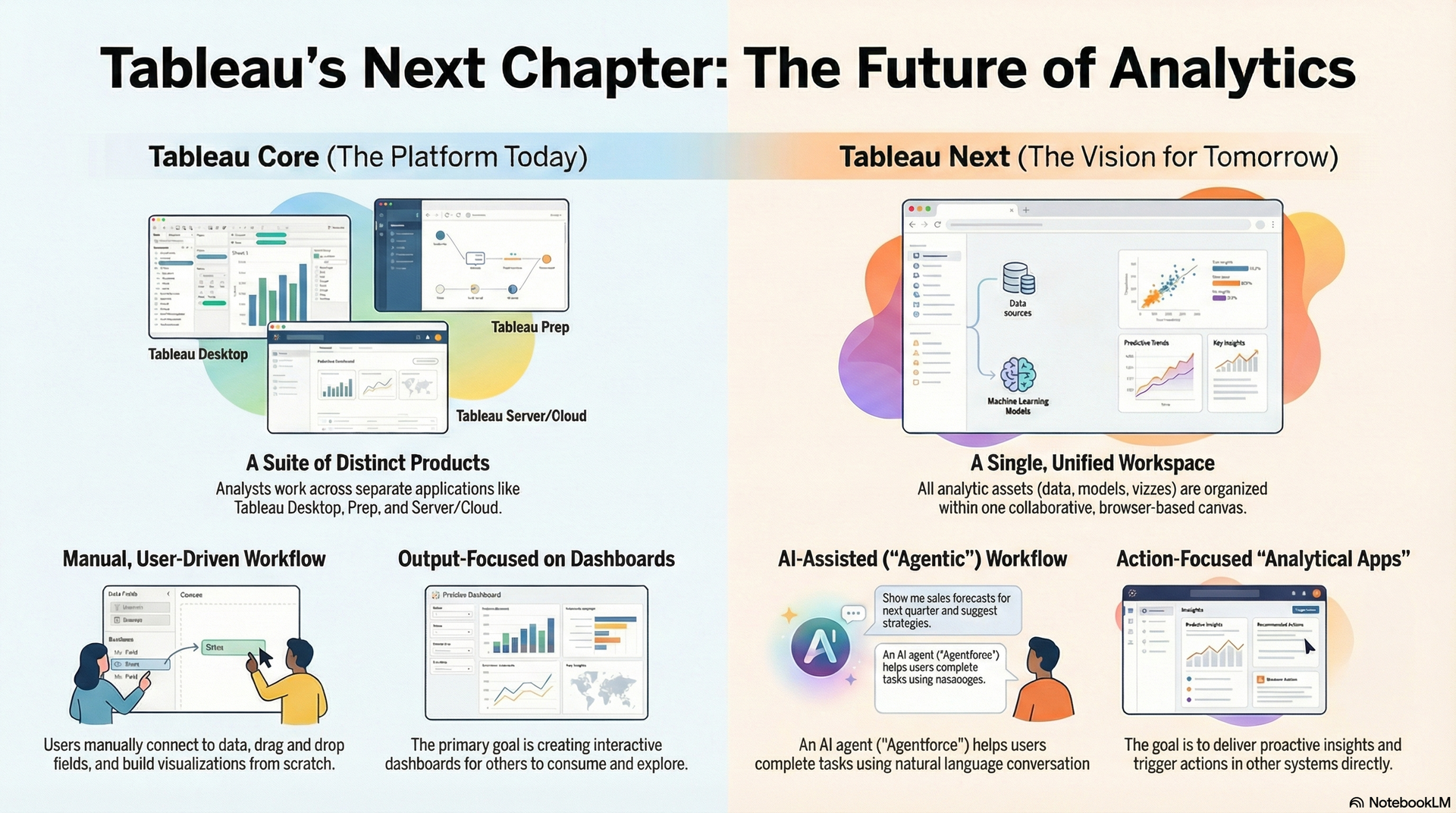
Infographic of Tableau Next using notebookLM
Was it perfect? No. Was it enough to get moving? Absolutely. The real learning came from experimentation. But the orientation came from AI.
I tried the same approach with the Air Force knowledge-management AFI. NotebookLM extracted the underlying physics: people, processes, technology, and the lifecycle of knowledge as an operational asset.
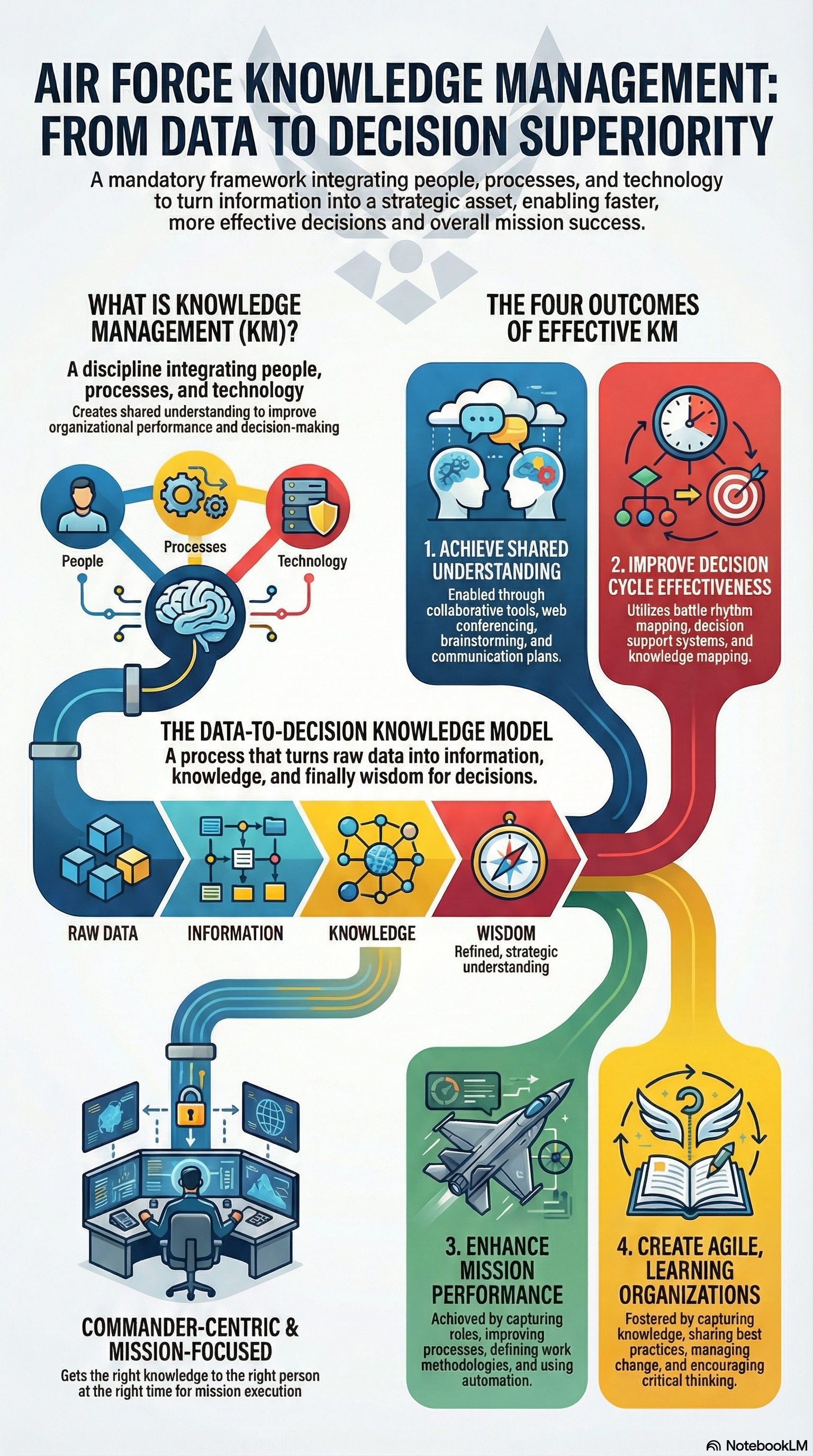
Infographic of Knowledge Management (KM) Air Force Manual (AFMAN) 33-396 using notebookLM
It won't replace reading the AFI. But it gives leaders the shared mental model they need before making decisions tied to that policy. It creates alignment before the meeting starts.
I tested the pattern again with publicly available CATM regulations from my earlier career field. NotebookLM distilled qualification cycles, maintenance tiers, and readiness expectations into a single frame.
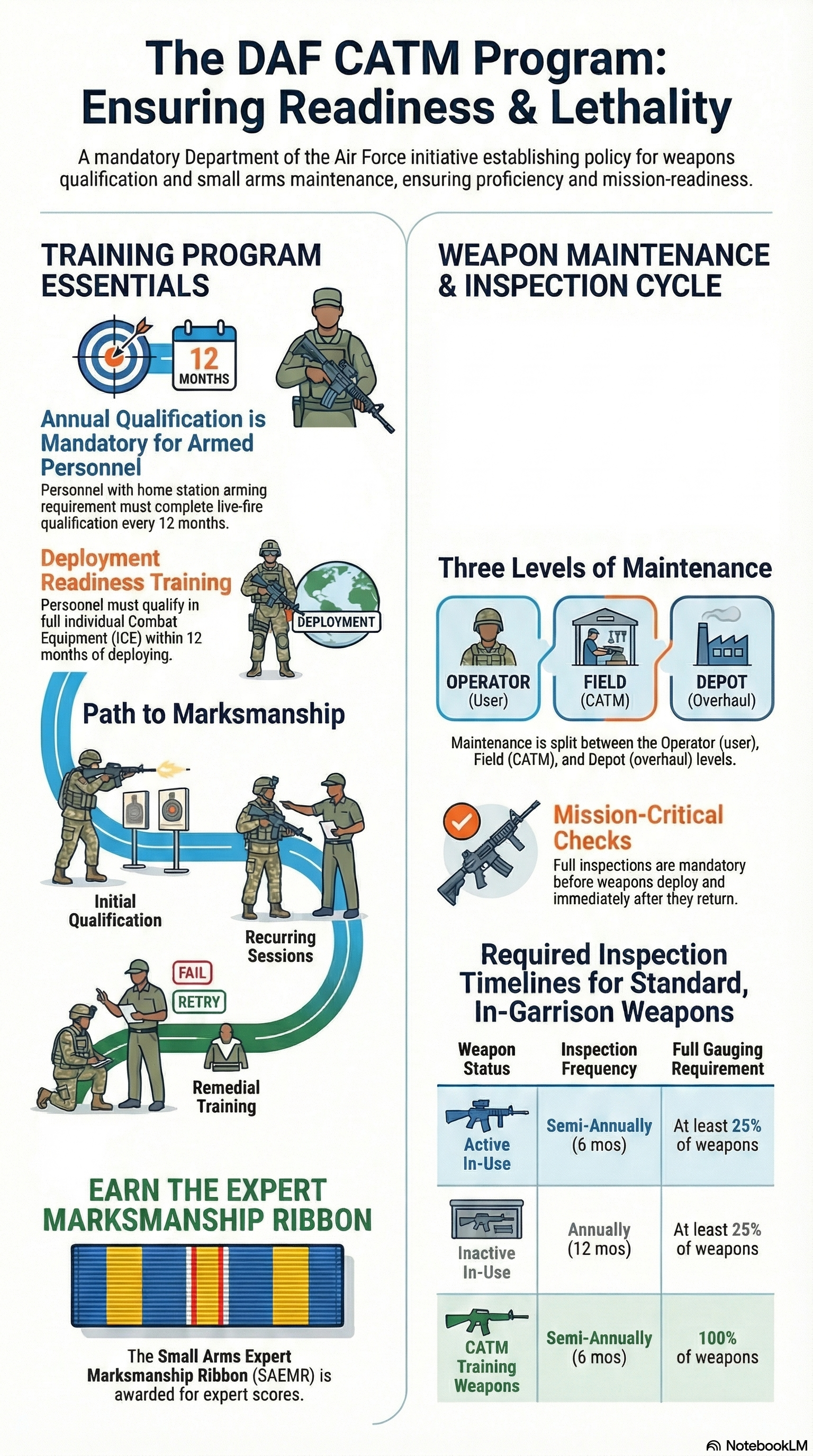
Infographic of Combat Arms Training and Maintenance (CATM) Department of the Air Force (DAF) 31-131 DAFI/DAFMAN using notebookLM
Directionally right. Imperfect. Immediately useful.
This is the pattern. Gather material. Load it. Ask for outputs that match your learning style. Then do the real work with more clarity and less friction.
Why this matters for leaders
Time is the true denominator. The faster you orient, the faster you decide and act.
The evidence is clear. A University of Minnesota and 3M study found that presentations with visual aids were 43% more persuasive than those without.² Visuals improve attention, comprehension, retention, and action. Leaders who use them move teams faster.
This approach doesn't outsource accountability. It strengthens it. Leaders reclaim the hours lost to blind starts. They build digital, data, AI, and functional literacy. They walk into conversations knowing the terrain. Teams onboard faster. Stakeholders align sooner. Decision cycles tighten.
Most leaders think the barrier is access. The real barrier is imagination. Most organizations already allow AI use with public data. Many provide approved internal environments for controlled content. The question isn't "Can I use this?" It's "What could this unlock if I did?" As an old boss put it well: if you never ask the question, the answer is always no.
AI gives leaders a way to create orientation on demand. Instead of waiting for perfect training products, they generate a tailored starting point in minutes. They move from consuming to shaping. They build clarity before conflict and understanding before action.
Guardrails and good practice
NotebookLM is one illustration. Ask Sage, Gamma, Gemini, and many others offer similar capability. The principle is constant across tools: turn raw material into structured insight.
Respect organizational boundaries. Use public data unless you're operating in an approved environment. The rules matter. They protect missions, teams, and trust.
Aim for good enough. Not perfection. This is orientation, not adjudication. It gives you the first slice of clarity so your judgment can handle the rest.
The goal is simple. Get time back. Reduce friction. Improve clarity. Build capability. Equip yourself and your teams with faster mental models so you can invest your energy where it counts.
Leaders who learn at speed lead with advantage.
Sources
¹ Medina, J. (2014). Brain Rules: 12 Principles for Surviving and Thriving at Work, Home, and School. Pear Press. https://brainrules.net/vision
² University of Minnesota / 3M Corporation study, as cited in: Huang, S., Martin, L.J., et al. (2020). "Maximizing impact with infographics." Canadian Pharmacists Journal. https://pmc.ncbi.nlm.nih.gov/articles/PMC7605071/
