
Efficient by Design: Why Teams Who Eat Their Own Dog Food Win
BLUF | Real efficiency happens when leaders design operations with intent, align people and systems, and turn practice into progress.
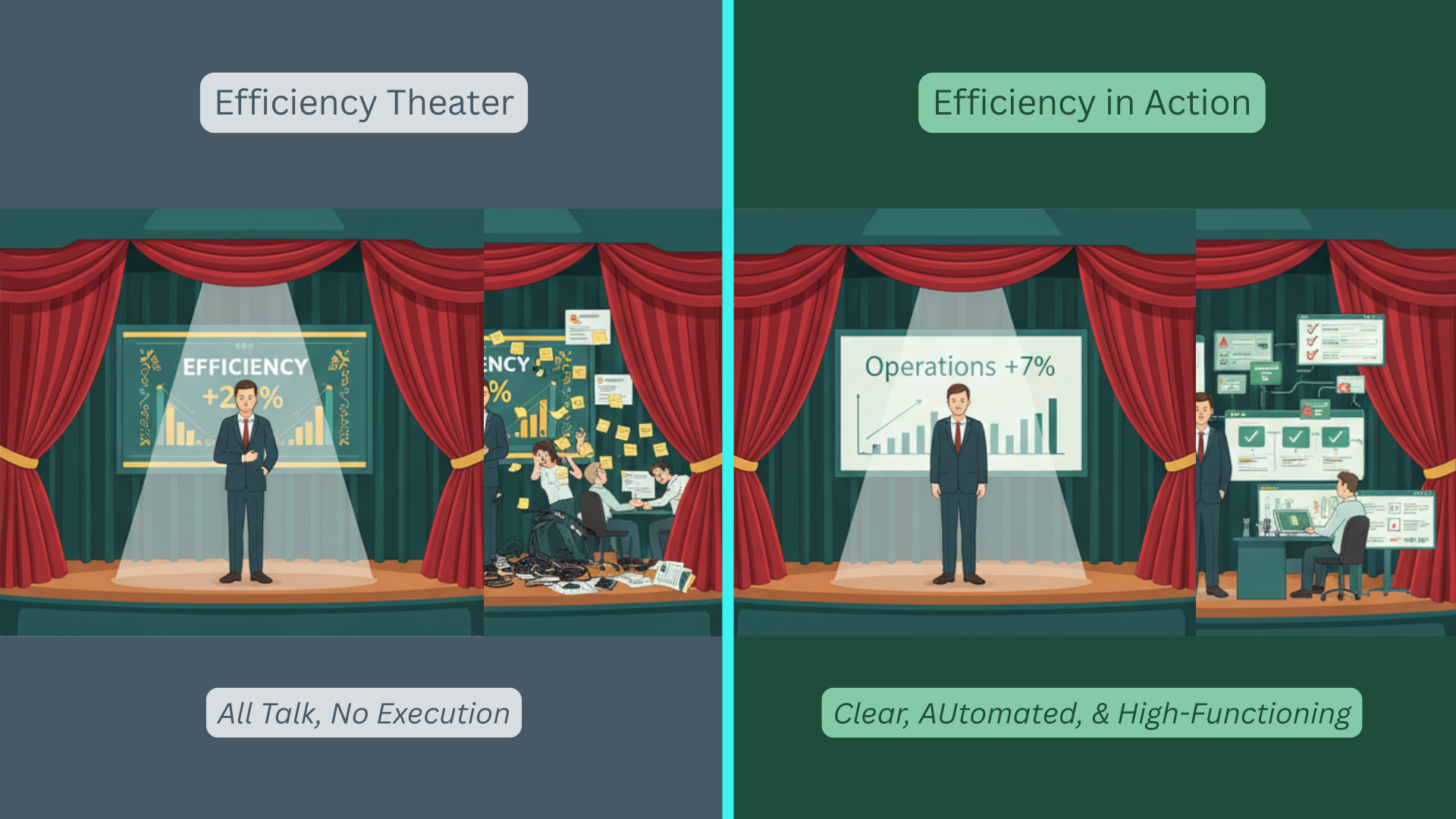
Image of efficiency theater compared efficiency in action (image by J Eselgroth with Gen AI)
Why Efficiency Still Feels Out of Reach
The most effective organizations aren’t efficient by accident. They are efficient by design. They build systems that fit the way people actually work. They align data, process, and purpose so decisions flow instead of stall. Whether it’s a growing business trying to scale or a public program under pressure to deliver more with less, the goal is the same: remove friction and make every dollar count.
This year, 53 percent of leaders say productivity must increase, yet 80 percent of the global workforce say they lack the time or energy to do their work (Source: Microsoft Work Trend Index 2025). The demand for more output is clear, but the capacity to deliver it is stretched thin.
Too often, efficiency becomes a slogan instead of a strategy. Leaders invest in tools, launch transformation projects, and celebrate new dashboards. Then, six months later, the same bottlenecks reappear under new names.
True efficiency is not something you buy. It is something you build. It is a design choice, not a by-product.
The Efficiency Gap
Every organization measures efficiency. Few improve it. Dashboards and KPIs make it look like progress is happening, yet inside the system, work still crawls through approvals, duplicate efforts, and manual processes. It is the same story in both small businesses and large enterprises: everyone tracks activity, but few improve outcomes.
This disconnect—the efficiency gap—represents the space between performance metrics and operational reality. For small and midsize businesses, that gap eats into margins. For government and enterprise programs, it slows results and erodes trust.
Closing the gap means rethinking how we define progress. Efficiency is not about doing more work faster. It is about designing smarter systems making the right work easier to do.
The Efficiency Boom That Isn’t
Search interest for “operational efficiency” (Google Trends - Picture below) is higher today than at any point since Google began tracking it. Everyone wants to be efficient. Yet the rise in curiosity has not produced a rise in capability.
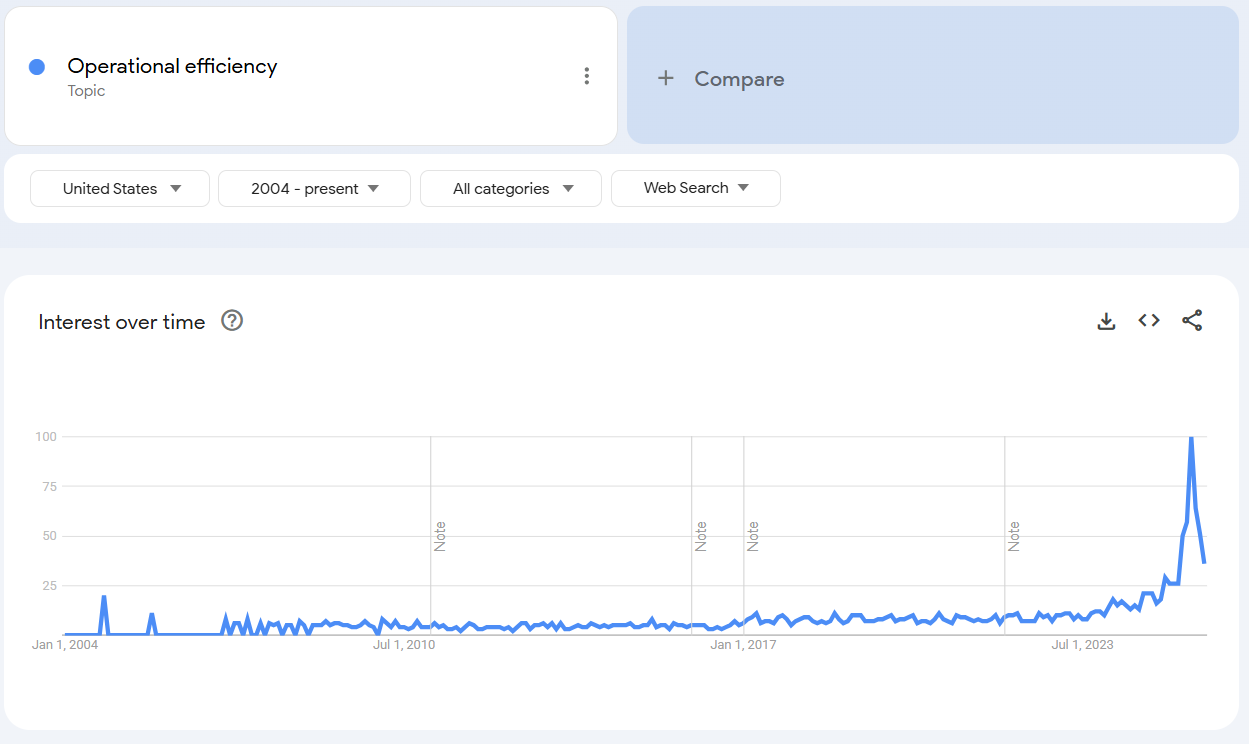
Image of the topic Operational efficiency trendline on Google Trends (screenshot of Google Trends by J Eselgroth)
Recent research underscores the point. PwC found that 57 percent of operations leaders have integrated AI into at least one business function, yet 92 percent say those tech investments have not fully delivered expected results. Similarly, McKinsey reports that while 88 percent of organizations now use AI in at least one area, only about one third have scaled it successfully.
The conclusion is clear: efficiency has become a performance, not a practice. Organizations talk about it, report on it, and market around it, but few live it. The intention is real, but the follow-through is missing. The path from knowing to doing remains broken.
Who Actually Walks the Talk
Picture a simple two-by-two grid. I call it the Dog food Index. One axis shows how loudly a team talks about efficiency. The other shows how deeply it practices it.
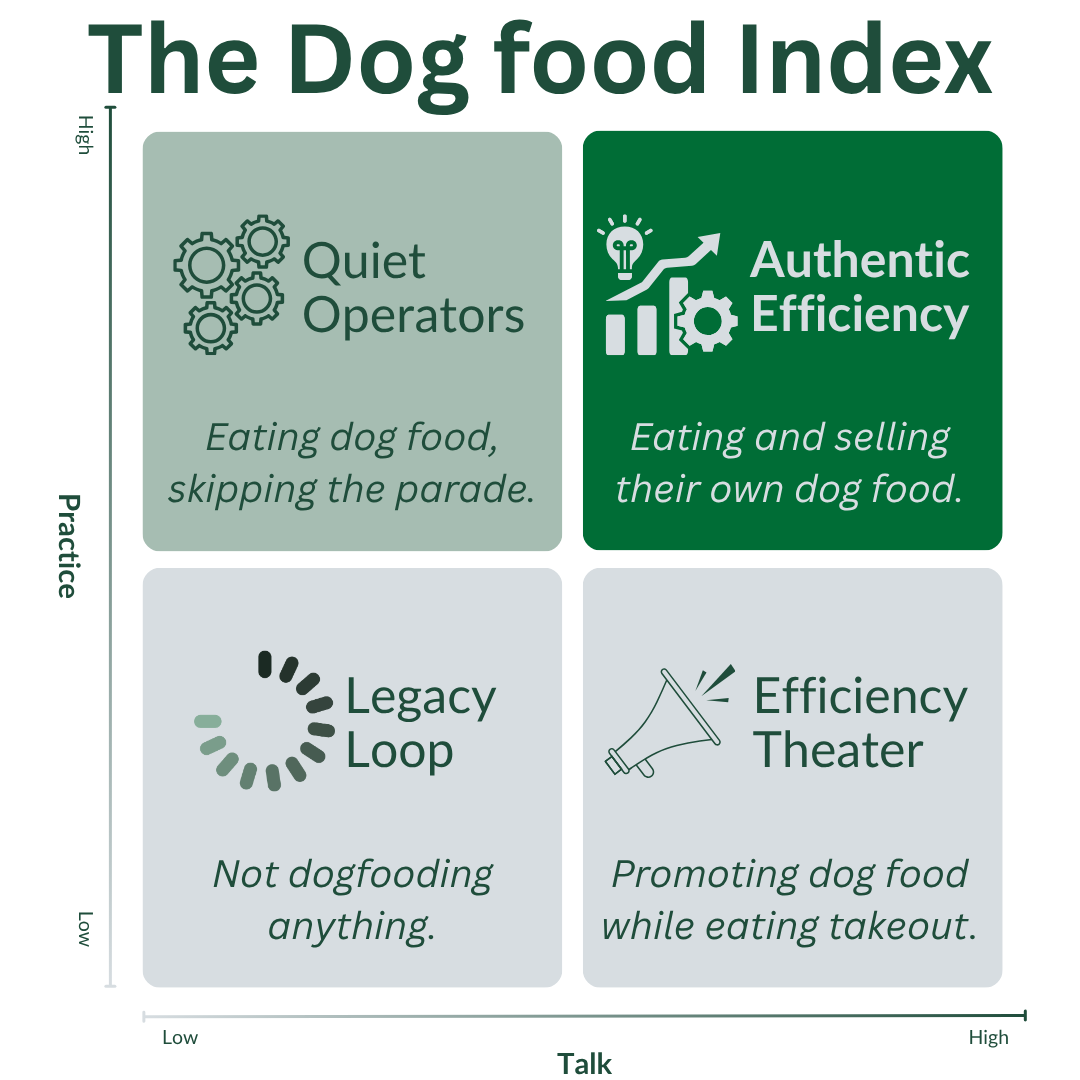
Image of the Dog Food Index, a 2 by 2 matrix showing how practicing and talking relate (image by J Eselgroth)
In the lower right sits Efficiency Theater, the loudest voices with the least discipline. In the upper left, the Quiet Operators, teams that don’t market efficiency but embody it. And in the upper right, a rare group that walks the talk:
- Amazon, where every team was required to expose its services through APIs long before “digital transformation” was trendy (Bezos API Mandate)).
- Atlassian, which runs its own operations on Jira and Confluence (How Atlassian Uses Confluence)).
- Microsoft, which acts as “customer zero” for Copilot (Microsoft Customer Zero)).
- Notion, which manages Notion on Notion (How Notion Uses Notion).
These organizations prove efficiency from the inside out. They don’t just measure ROI; they generate it through design. They improve by testing on themselves first. Their products work because their operations demand it. The real takeaway: efficiency isn’t about what you say, it’s about how you operate when no one is watching. That’s also called integrity.
From Burden to Advantage
For many leaders, especially in small and midsize organizations, the back office can feel like a necessary evil. Compliance, reporting, and operational overhead consume time that could be spent creating value. But what if efficiency became an advantage instead of an obligation?
Efficiency can shift from burden to advantage. Augmented intelligence makes this possible. Automation handles repetitive tasks. RPA clears routine work. Generative AI speeds documentation and insight. Predictive analytics guides decisions before issues appear. These tools create space for real thinking and real impact.
A recent Vistage study found that 63 percent of companies reporting higher productivity also saw increases in profitability, and 72 percent reported revenue growth. Efficiency doesn’t just cut costs; it creates opportunity.
This is not about replacing people. It is about amplifying them. Technology should clear the runway, not compete for control of the cockpit.
What Leaders Can Do Next
Efficiency only becomes real when leaders slow down long enough to see how work truly gets done. Intelligent transformation begins with honest reflection, not more tools or louder messaging. When leaders understand the truth of their operations, they see the patterns that move work forward and the anti-patterns that quietly slow it down. This quick scan helps teams understand where they stand and what needs to change.
| Patterns | Anti-Patterns |
|---|---|
| Seeing the system as it is | Dashboards over reality |
| Fixing friction before adding tools | Tool-first transformation |
| Dogfooding early and often | Marketing efficiency instead of practicing it |
| Designing for clarity | Decision bottlenecks everywhere |
| Automating the predictable | Workarounds becoming the real process |
| Measuring outcomes, not activity | Solving old problems with new jargon |
A Simple Starting Path
Real progress begins with awareness. Leaders improve operations by seeing their system clearly, fixing obvious friction, and automating where it serves people and purpose. Testing changes on themselves first strengthens integrity and builds trust. Intelligent transformation grows through steady practice, not bigger claims.
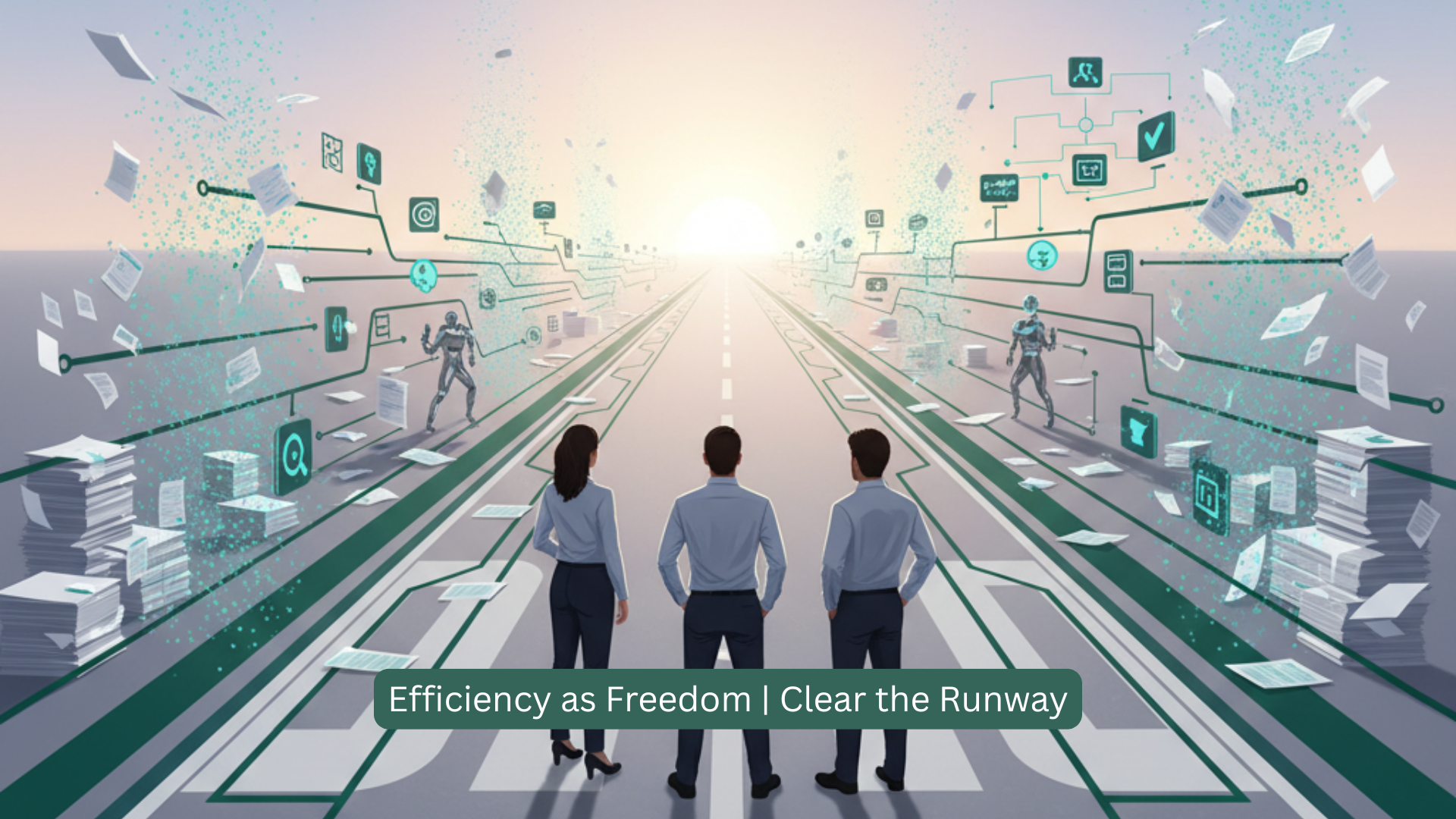
Image of a runway being cleared visualizing tasks being moved out of the way (Image by J Eselgroth with Gen AI)
Efficiency as Freedom
Efficiency done well creates freedom. Freedom for teams focusing on work that matters. Freedom for leaders building without chaos. Freedom for customers and citizens receiving value without delay.
The future will not reward more dashboards or louder talking points. It will reward leaders designing operations with intelligence and care.
Efficiency is not about moving faster. It is about moving with intent. It is about finally doing what you said you would. Consistently. Clearly. With purpose. Better operations create better lives. The work improves so the person can breathe again.
Sources
- Microsoft Work Trend Index 2025. “The Year the Frontier Firm Is Born.”
- PwC Digital Operations Insights 2025.
- McKinsey State of AI Report 2025.
- Vistage Research. “Productivity and Profitability Trends” 2025.
