Bending the Iron Triangle: Why Intelligent Transformation Makes Old Constraints Malleable
BLUF | The Iron Triangle is not dead. It becomes malleable when intelligent transformation changes the materials, not the physics. But to bend it, you must first survive the effort hump.
The Old Laws Still Echo
An old friend in firearms development reminded me recently: "Signature, lethality, mobility. Pick two." It's the weapons designer's iron triangle. Reduce signature, sacrifice mobility. Max lethality, signature grows. Another friend of mine in a different conversation reminded me: "Quality, time, features. Pick two." It's the software engineer's iron triangle. Increase features and meet quality standards, it'll take more time. Want features faster, either choose fewer features or be prepared to sacrifice quality.
We keep discovering the same constraint everywhere. But in 2025, in the age of AI, what if we can bend these laws?
The Three Mirrors
Across industries, domains, and decades, we keep running into the same immutable shape. Whether designing weapons, building software, or modernizing enterprises, leaders face a repeating pattern of constraint. Different contexts change the vocabulary, but the structure stays the same. And understanding these mirrors is the first step toward bending them.
- The Iron Triangle (software): Time, Features, Quality
- The Mission Triangle (weapons): Signature, Lethality, Mobility
- The Transformation Triangle (AI era): Speed, Cost of Ownership, Decision Velocity
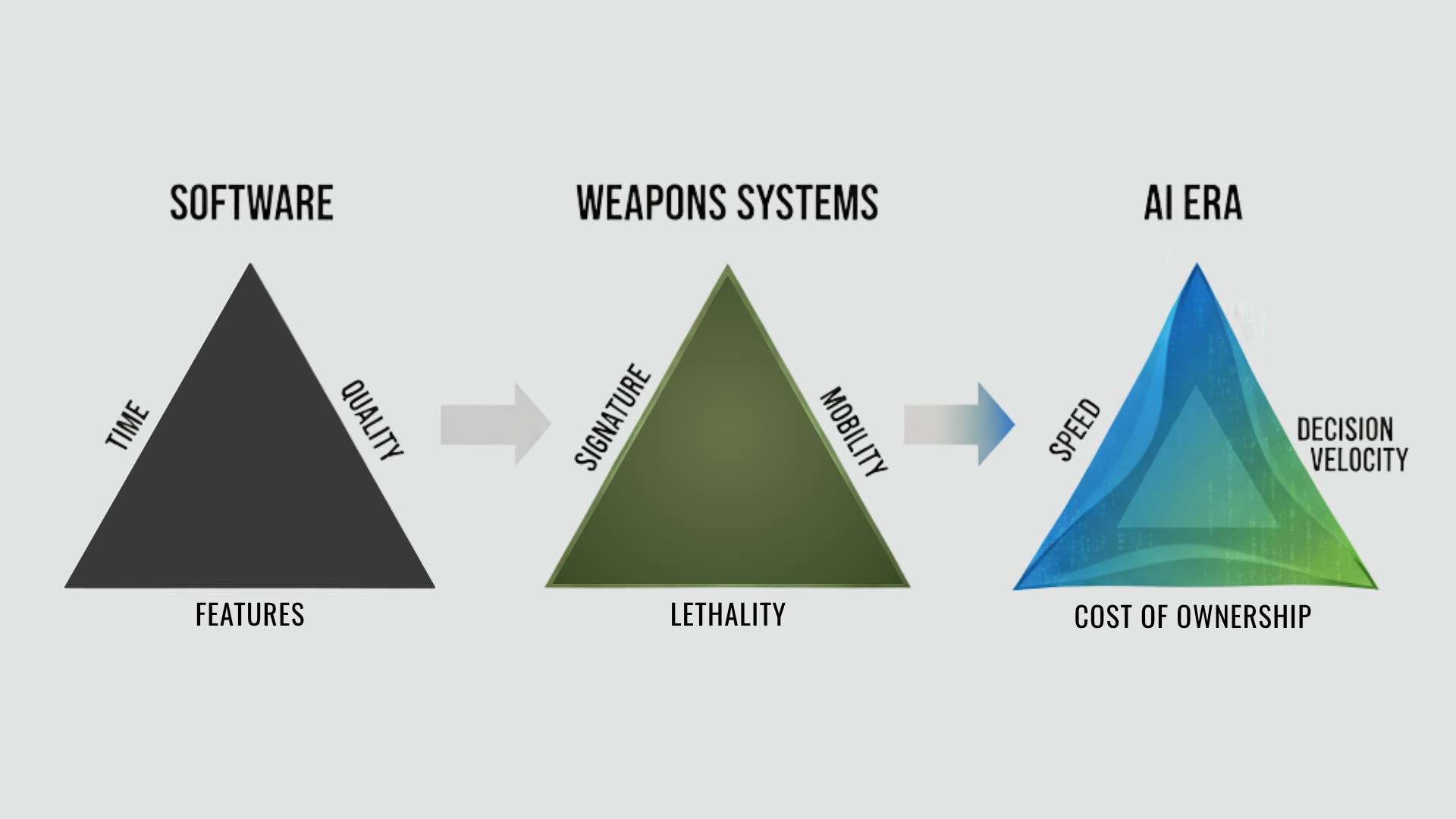
Three triangles same system of trade-offs (Image by J Eselgroth with GenAI)
One universal truth: trade-offs never disappear. But in the age of AI, their behavior changes.
- Compute replaces labor.
- Automation compresses time.
- AI augments quality.
The constraint remains. The materials shift.
The Effort Hump
If you look at the two charts that accompany this section, you can actually see this story play out. The first curve shows the traditional digital transformation lifecycle, with its steep climb, second spike, and long tail of stabilization. The second curve overlays Intelligent Transformation on top of it and makes the contrast impossible to ignore. The shapes are familiar, but the behavior changes. The peaks flatten. The dips smooth out. The entire system becomes easier to manage.
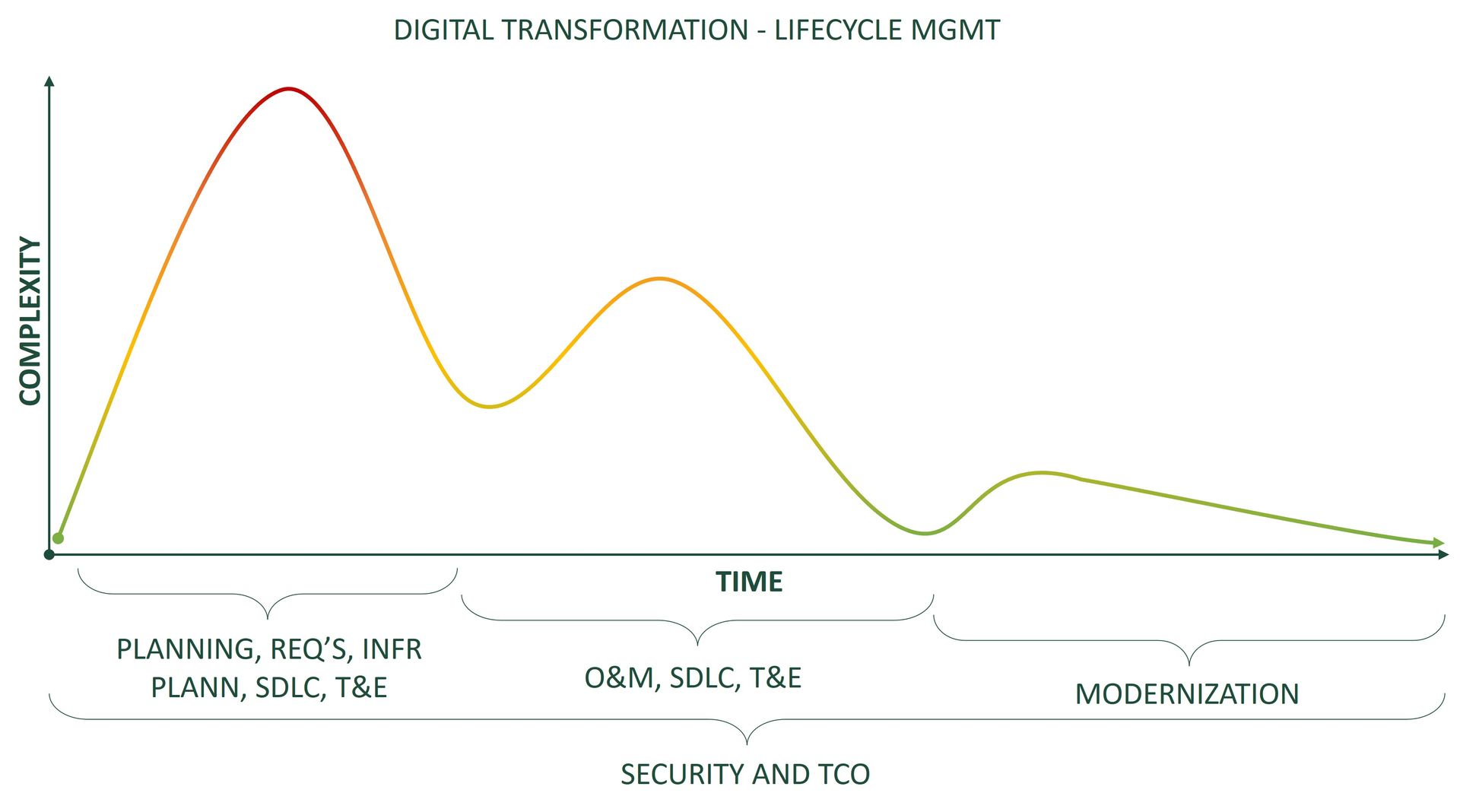
The Digital Transformation Curve time and complexity (Image by J Eselgroth)
Transformation often begins with optimism and the promise of speed, efficiency, and improvement. Then reality arrives. The effort hump appears, the steep rise in complexity before benefits become visible. Teams retrain. Processes shift. Governance tightens. New tools collide with old patterns. This phase demands maximum cognitive load. Requirements take time. Infrastructure planning requires alignment. Testing and evaluation add weight. Security threads through everything.
In traditional transformation, a second bump follows as teams struggle to settle into new rhythms, creating friction and unplanned effort.
Now look at the Intelligent Transformation curve.
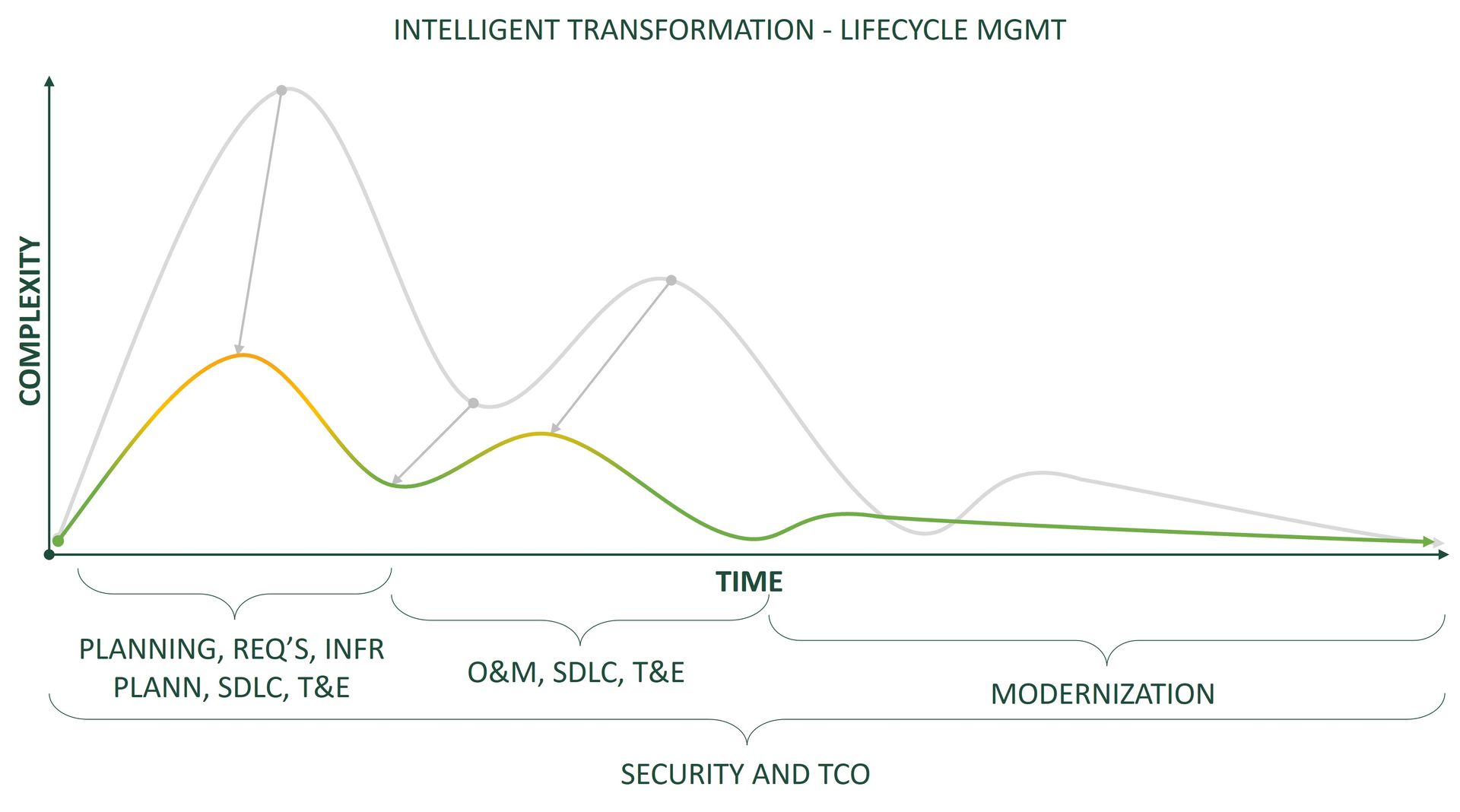
Intelligent Transformation curve, where complexity reduces and time to value increases (image by J Eselgroth)
This is where the orchestration layer truly appears. During this phase you:
- Establish you approach to the 5Ps (People, Policy, Process, Partners, Platforms)
- Build your Business (or Mission) Body of Knowledge
- Redesign foundational workflows
- Define requirements and alignment
- Coordinate infrastructure planning
- Test systems and integrate security
- Stabilize operations and maintenance
The phases remain, but the amplitudes shrink. The first spike drops by roughly 40 percent. The O&M bump almost disappears. Modernization arrives sooner and with less strain. AI does not remove the journey. It reduces the pain. Automation absorbs repetitive tasks during planning. Machine learning accelerates validation and testing. Intelligent systems smooth the transitions that normally cause turbulence.
Key insight: Never exceed the first bump in maximum effort. Over time everything should become easier and simpler.
The gray ghost line shows the traditional path. The colored line shows intelligence bending effort itself. New materials reshape the experience, making old constraints manageable.
From Violinists to Conductors

From Violinists to Conductor (Image by J Eselgroth)
Many organizations hold modern tools but operate with old mental models. They treat AI like another instrument rather than a shift in how work happens. The old world depended on violinists. Craftsmanship lived in the hands. Quality depended on execution. Speed was limited by human capacity.
The new world needs conductors. Humans set intent, sequence, and tempo while AI-powered tools perform the heavy lift. Agentic workflows, generative models, and automated pipelines become the instruments. Humans shape the outcome.
This pivot redistributes the physics:
- Speed comes from automation
- Cost shifts to compute
- Quality emerges from orchestration
Organizations failing to make this shift scale inefficiency. Those that do, unlock momentum and bend the Iron Triangle toward advantage.
The Super-Serum Principle
The same tension we see in the triangles shows up here too. Tools do not change your fundamentals. They exaggerate them. The same formula that created Captain America created the Red Skull. Technology amplifies what already exists.
- Sloppy processes? AI scales sloppiness.
- Strong standards? AI scales excellence.
- Corner cutting? AI accelerates it.
Craftsmanship still determines trajectory. AI magnifies your habits, good or bad, and this is why bending the Iron Triangle requires discipline before acceleration.
Good Enough vs. Perfect
Quality becomes a managed continuum in the AI era, and leaders must rethink what progress looks like. The 80/20 rule still applies, but the rhythm changes.
- AI gets you to ~80% faster, the heavy lift handled in seconds.
- Humans refine the work to 90 to 95%, applying judgment, nuance, and context.
- Perfection still wastes resources and almost never pays back.
"Good enough" paired with decision velocity outperforms "perfect" delivered late, every time. Momentum beats polish when polish delays impact.
This is where expectation management becomes mission critical. It is no longer a soft skill. It now sits beside prompt engineering as a foundational discipline. When expectations are unclear, quality debt accumulates fast.
Speed without quality does not create value. It just produces bad outputs quicker. The fixes' cost more. Teams burn out. Trust erodes in ways that can take years to repair.
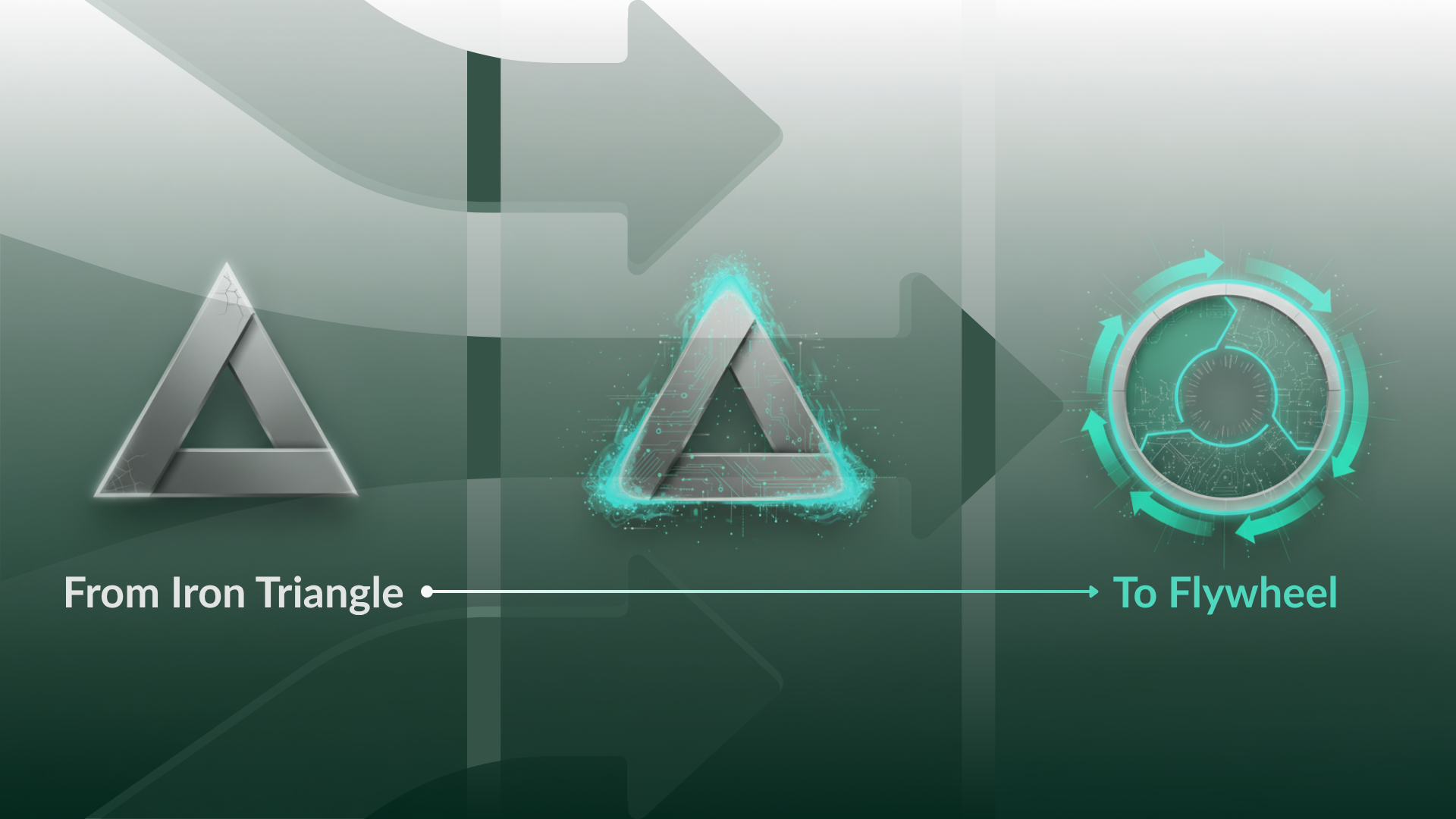
From Triangle to Flywheel
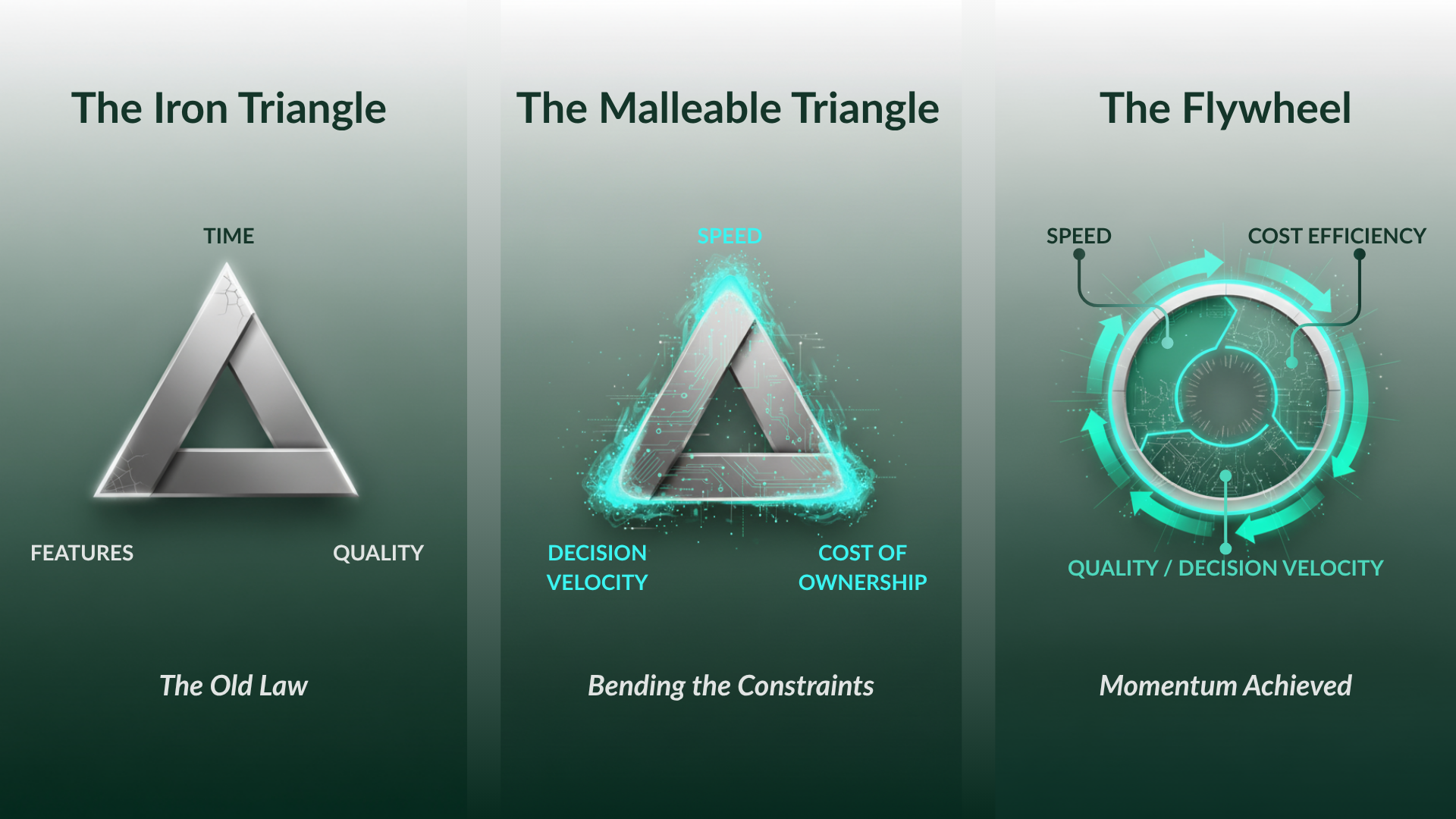
From Iron, through malleability, and morphing into the flywheel (Image by J Eselgroth with Gen AI)
The Iron Triangle assumes static trade-offs, fixed levers you push and pull and hope to balance. Intelligent transformation changes that posture. It replaces static constraint with dynamic motion.
Think about the flywheel as the moment when a system stops resisting progress and starts reinforcing it. Each rotation builds upon the last. Each improvement strengthens the next. It is the shift from forcing progress to enabling it. Each rotation of the flywheel:
- Increases decision velocity
- Reduces cognitive friction
- Improves outcomes
- Reinforces learning
The triangle stops behaving like a box of limits and starts acting like a loop of compounding returns. It becomes dynamic, a self-improving system instead of a static set of trade-offs.
Momentum replaces trade-offs.
The Real Calculation
In my "Data-Driven Theater" analysis, a 93-slide briefing cost $241,881. The ratio was 1:3, one hour of creation for every three hours of review.
When intelligence enters the workflow, that ratio collapses. AI generates drafts in minutes. Humans validate in minutes. Creation and refinement finally move at the speed leaders expect. This is not cost-cutting. It is bandwidth reclamation. It frees teams to focus on decisions instead of production.
The entry fees remain: governance, training, integration. Once paid, returns compound quickly. Humans orchestrate. Machines execute. Work shifts from force to flow.
We turn bureaucracy into bandwidth and constraint into capability.
Transformation begins by meeting people where they are. Start with familiar constraints. Show how new materials bend them. Physics stays constant. Materials evolve.
Where You Go From Here
Your transformation either bends the Iron Triangle or it does not. If it does not, you are adding expensive technology to yesterday’s problems. Speed, cost, and quality can improve together, but only after you pay the entry fees. You must move through the effort hump, guide the human shift, and build a foundation for continuous learning.
The triangle is no longer iron. It becomes malleable when the right forces are applied. Bending takes intention. It takes discipline. It takes leadership willing to rethink how work gets done.
What's your developer-to-bureaucracy ratio? More importantly: Does your transformation bend the Iron Triangle or just paint it differently?
If you want help bending your triangle, contact me. I have spent my career helping organizations navigate these trade-offs. Weapons systems or AI systems, the physics stay the same.
