
The Unending Quest for Efficiency: Navigating Beyond Digital Transformation
BLUF | Digital transformation is not the finish line. True leaders pursue continuous improvement through efficiency, innovation, and adaptability.
The year 2013 marked a turning point in the business world with the introduction of the term "digital transformation."1 Over a decade later, a striking “70% of companies either have a digital transformation strategy in place or are actively working on one”2. However, as the digital landscape becomes increasingly saturated, simply having a strategy is no longer enough. Organizations must go beyond initial adoption and focus on continuous innovation and optimization to extract maximum value from their investments. Even for the “21% of companies that believe they've completed their digital transformation”3, the journey is far from over. The question for these organizations is not 'Are we done?' but rather 'What's next?' The focus must shift from achieving a static state of digital maturity to embracing a mindset of continuous evolution and adaptation.
The Digital Efficiency Matrix: A Roadmap for Progress
To understand where we stand and where we can go next on this journey, we introduce the Digital Efficiency Matrix. This 3x3 grid provides a comprehensive view of an organization's digital maturity and efficiency, guiding us toward the ultimate goal of becoming leaders in our respective industries.
Understanding the Axes
- Efficiency (X-Axis): This axis measures how effectively an organization utilizes its resources (time, money, labor, etc.) to achieve its goals. It ranges from low efficiency, characterized by high manual labor, low compute power, and high costs, to high efficiency, marked by minimal manual labor, extensive compute power, and lower costs.

- Digital Maturity (Y-Axis): This axis represents the extent to which an organization has adopted and integrated digital technologies into its operations. It spans from paper-based processes to intelligent/autonomous systems that leverage AI and machine learning.

The Journey So Far: The Inner 2x2 Matrix
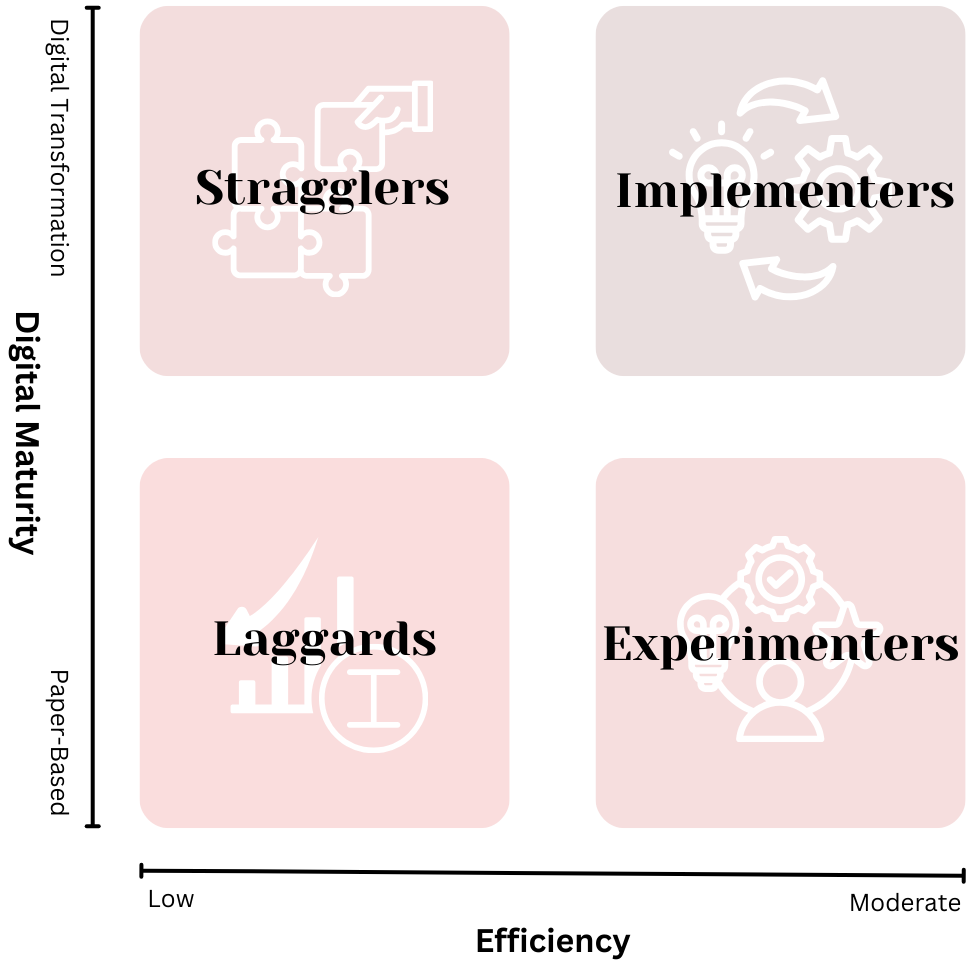
Traditionally, organizations have been assessed using a simpler 2x2 matrix, focusing on basic levels of digital maturity and efficiency. This matrix identified four quadrants:
- Laggards: Low efficiency, low digital maturity
- Stragglers: Low efficiency, moderate digital maturity
- Experimenters: Moderate efficiency, low digital maturity
- Implementers: Moderate efficiency, moderate digital maturity
The Path Forward: The Expanded 3x3 Matrix
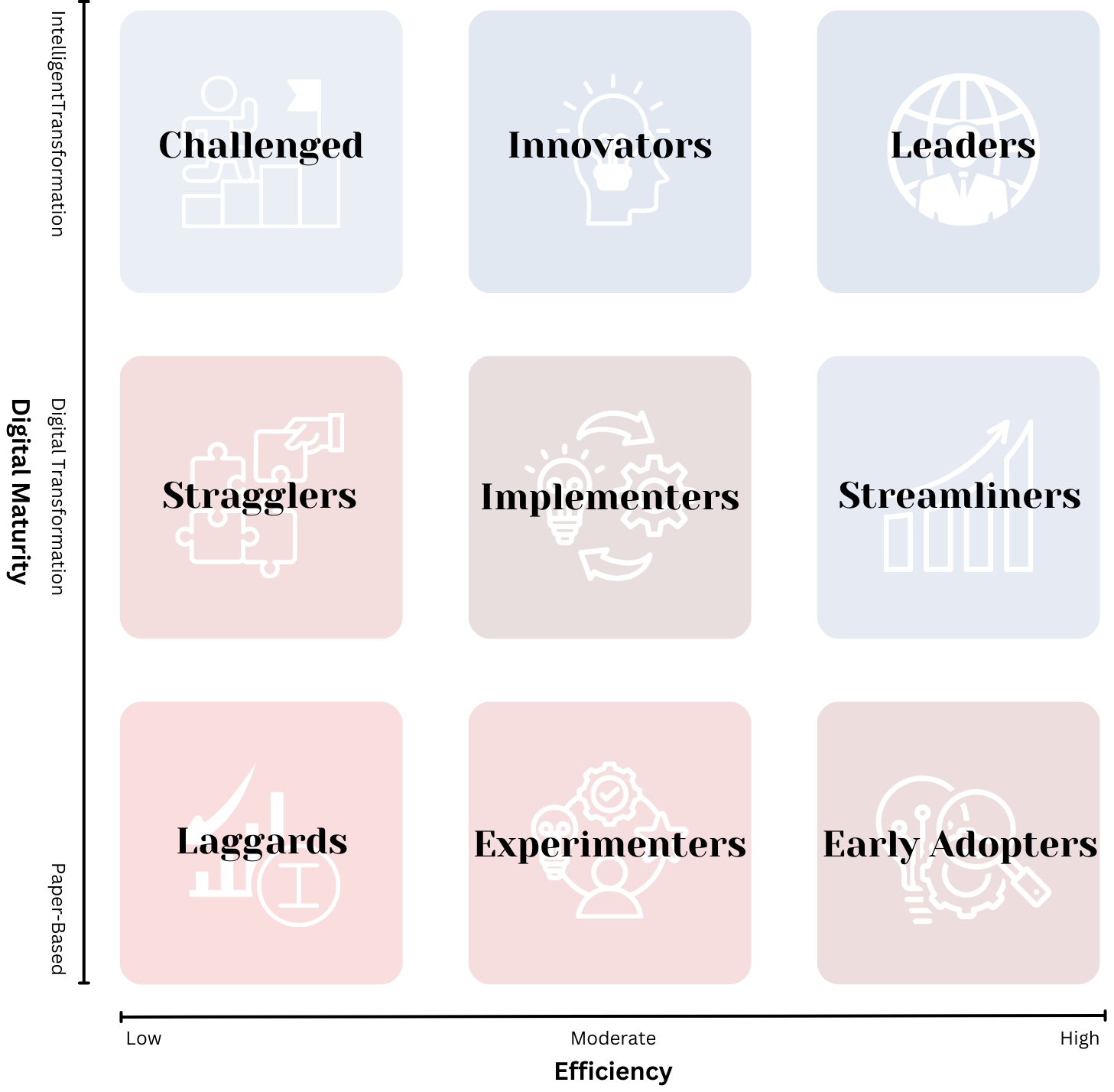
The expanded 3x3 matrix offers a more nuanced perspective, revealing new possibilities and potential paths for organizations to advance:
- Early Adopters: Moderate efficiency, high digital maturity
- Challenged: Low efficiency, high digital maturity
- Streamliners: High efficiency, moderate digital maturity
- Innovators: Moderate efficiency, high digital maturity
- Leaders: High efficiency, high digital maturity
Charting Your Course: Where Are You Now, and Where Can You Go?
The first step in any successful strategy is understanding your current position. By identifying your organization's location within the Digital Efficiency Matrix, you can gain valuable insights into your strengths and weaknesses and chart a course toward greater efficiency and digital maturity.
Descriptions and Strategies
- Laggards: Organizations in this location are heavily reliant on manual, paper-based processes. They often experience high operational costs, slow turnaround times, and a higher risk of errors due to the manual nature of their work. To progress, they should focus on basic digitization efforts to kickstart their digital journey.
- Experimenters: These organizations are taking their first steps into the digital realm, experimenting with new tools and processes. While they are making some progress, their efforts are often scattered and not fully integrated. Investing in digital tools and training can help them improve efficiency and move towards higher digital maturity.
- Early Adopters: These organizations have embraced digital technologies early on but may lack a cohesive strategy. They are seeing positive results in specific areas but have the potential to achieve even greater efficiency by expanding their digital initiatives and developing a comprehensive digital strategy.
- Stragglers: These organizations have adopted some digital tools but are not using them effectively, leading to limited efficiency gains. This could be due to a lack of training, poor implementation, or resistance to change. To overcome these challenges, they should focus on optimizing processes and enhancing their digital capabilities.
- Implementers: These organizations are systematically implementing digital technologies and are seeing moderate improvements in efficiency. To maintain momentum, they should continue to refine and expand their digital initiatives.
- Streamliners: These organizations have well-integrated digital systems and automated workflows, leading to high efficiency. They use data to make informed decisions and continuously optimize their processes. To further advance, they can enhance digital innovation and explore emerging technologies.
- Challenged: These organizations possess advanced technology but face challenges in implementation and achieving efficiency. Addressing inefficiencies by optimizing digital tools and processes is key to unlocking their full potential.
- Innovators: Organizations in this category exhibit high digital maturity and moderate efficiency. They are innovative but may need to enhance efficiency by focusing on scaling innovations and improving process efficiency.
- Leaders: These organizations are at the forefront of digital transformation and efficiency, leading in both digital innovation and process optimization. To maintain their leadership position, they must continue to push boundaries, set benchmarks, and embrace a mindset of continuous evolution and adaptation.
Overcoming Challenges and Embracing Continuous Improvement
While the journey towards digital maturity and efficiency is promising, it's not without its challenges. Organizations may encounter obstacles such as resistance to change, a lack of skilled talent, and difficulty measuring ROI. Strong leadership, a clear vision, and a commitment to continuous improvement are essential for overcoming these hurdles and achieving long-term success. (read about why the 5Ps are essential to Digital Excellence)
The Role of Leadership
Leaders play a crucial role in driving digital transformation and fostering a culture of continuous improvement. They must champion the adoption of new technologies, invest in employee training and development, and create an environment that encourages experimentation and innovation.
The Power of Continuous Improvement
In the dynamic digital landscape, there is no finish line. Organizations must embrace a mindset of continuous improvement, constantly seeking ways to optimize processes, leverage new technologies, and enhance efficiency. By doing so, they can stay ahead of the curve, adapt to changing market conditions, and achieve sustainable growth.
Conclusion
The pursuit of efficiency is an ongoing journey, not a destination. While digital transformation has been a significant step for many organizations, it's essential to recognize that the quest for improvement never ends. By leveraging the Digital Efficiency Matrix, organizations can gain a clearer understanding of their current state, identify areas for growth, and develop strategies to achieve higher levels of digital maturity and efficiency. With a focus on continuous innovation and adaptation, organizations can navigate the complexities of the digital age and thrive in the years to come.
Footnote
- 2013 The term “Digital Transformation” is coined (Hatchworks)
- 70% of companies either have a digital transformation strategy in place or are working on one. (Tech Pro Research)
- 21% of companies believe they’ve completed their digital transformation. (Forrester)
