
Decision Intelligence: The Missing Piece in AI Orchestration?
BLUF | Decision Intelligence bridges data, technology, and human insight to orchestrate AI effectively, transforming fragmented efforts into real-world outcomes.
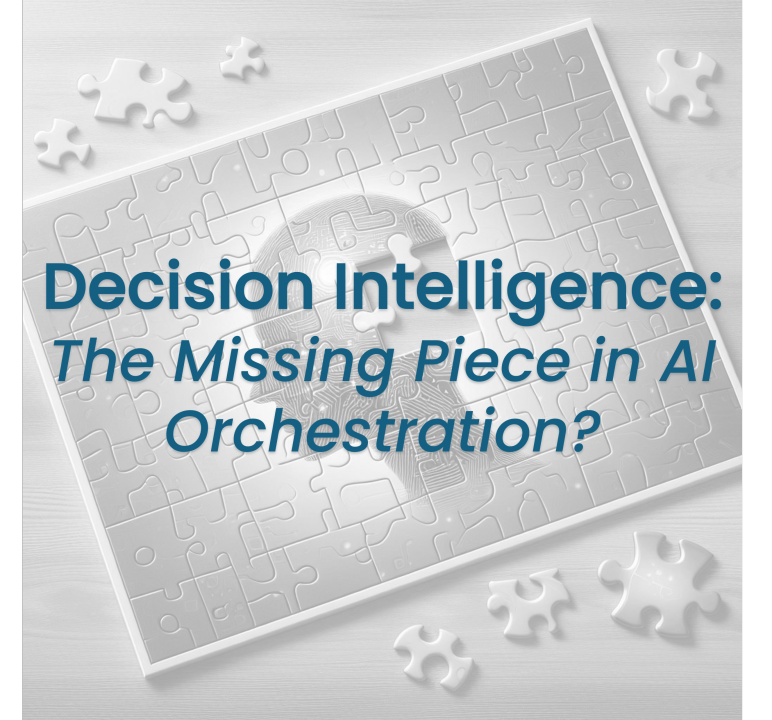
In the world of AI, "Most AI projects fail. Some estimates place the failure rate as high as 80%". Simultaneously, the buzz around Decision Intelligence (DI)* is growing. Could DI be the key to AI orchestration? In my view, the answer is both yes and sort of.
AI orchestration, while promising, presents a myriad of challenges. On the technical side, the complexity of managing diverse AI components, ensuring scalability with growing data volumes, and integrating with existing systems can be daunting. On the human side, there are skill gaps in AI and software engineering, collaboration difficulties between teams, resistance to change due to workflow disruptions, and ethical considerations around data privacy and bias.
The Case for DI
To the "yes", DI brings together the often-disparate elements of data and technology into a unified strategy. It addresses the human element – the "squishy things" like subjectivity and intuition – that are often overlooked in AI implementations. Think of DI as the glue that holds everything together, focusing our efforts on making sense of the data available to us and transforming it into improved outcomes. When faced with the challenge of finding a needle in a haystack, DI helps us "burn the hay" – eliminating irrelevant data and focusing our efforts on the most valuable information. In essence, DI helps us cut through the noise and focus on finding the right data.

When trying to find the needle (the right data) in the haystack, we need to ask ourselves “what if we burned the hay?” (image developed with DALL-E)
However, to the "sort of", implementing DI isn't as simple as plugging it in and expecting magic. It requires a holistic approach, what I call the "digital transformation (DT) of becoming a data-driven decision organization." This means considering the impact on people, policy, process, partners, and platforms – the 5Ps.
The 5Ps: A Framework for Bridging AI Orchestration Challenges to Impactful Outcomes with DI
The 5Ps framework, when applied through the lens of Decision Intelligence (DI), can effectively bridge the gap between AI orchestration challenges and impactful organizational outcomes:
- People: DI empowers individuals by fostering a data-driven culture and enhancing decision-making skills. By investing in training and development, organizations can cultivate a workforce proficient in both AI and software engineering, mitigating the skills gap and fostering collaboration. This leads to improved communication, streamlined workflows, and reduced resistance to change, ultimately driving higher adoption rates and successful AI implementation.
- Policy: DI-driven policies establish clear ethical guidelines for AI, ensuring responsible and unbiased decision-making. By defining roles and responsibilities, organizations can create a governance framework that promotes transparency and accountability, mitigating risks and building trust in AI-powered systems. This results in ethical AI practices, reduced legal and reputational risks, and increased stakeholder confidence.
- Process: DI enables the design and optimization of processes that seamlessly integrate AI into existing workflows. By leveraging change management principles and involving employees in the process, organizations can minimize disruptions and ensure smooth transitions. This leads to increased efficiency, reduced errors, and improved decision-making across the organization.
- Partners: DI facilitates effective collaboration with internal and external partners, leveraging their expertise to overcome technical challenges and accelerate AI implementation. By identifying and managing partners, organizations can access specialized skills, knowledge, and resources, leading to faster time-to-market, reduced development costs, and innovative solutions.
- Platforms: DI guides the selection and implementation of scalable and flexible AI platforms that align with organizational needs. By ensuring compatibility with existing systems and incorporating robust monitoring and maintenance tools, organizations can maximize the value of their AI investments. This results in improved performance, enhanced scalability, and the ability to adapt to evolving business requirements.
From Lab to Reality: Bridging the Gap
While the 5Ps framework provides a solid foundation for addressing AI orchestration challenges, it's important to acknowledge the gap between theory and practice. Many AI initiatives that show promise in the lab fail to deliver the expected results in real-world scenarios. This can be due to various factors, such as unforeseen technical issues, organizational resistance, or a lack of understanding of the specific business context.
To bridge this gap, organizations can leverage DI to create a feedback loop that continuously improves AI models and their real-world performance. By applying DI principles, businesses can identify and rectify biases, refine algorithms, and ensure that AI systems align with evolving business objectives. This iterative process not only enhances the accuracy and effectiveness of AI but also fosters trust and transparency, crucial factors for successful AI adoption.
Start Small, Win Big
To win over leadership and ensure successful DI adoption, I advocate for a "start small" approach. Begin with small, impactful MVPs (Minimum Viable Products) that demonstrate the value of DI in real-world scenarios. These early wins can build momentum and pave the way for wider adoption. Find one problem the organization has been trying to answer, and start there. Focusing on a single problem instead of trying to boil the ocean allows you to learn and finetune before doing more. The momentum from, hopefully, a successful DI implementation encourages others to participate and simultaneously improve leaderships confidence DI. After all, as I discovered in my master years ago, in order for change to be accepted by all, it must start off small.

AI orchestration (image developed with DALL-E)
"In order for change to be accepted by all, it must start off small" - James Eselgroth
Final Thoughts
Decision Intelligence has the potential to revolutionize AI orchestration. By focusing on the right data and "burning the hay" of irrelevant information, DI empowers organizations to make better, faster, and more informed decisions. But to realize its full potential, organizations need to take a holistic approach, considering the 5Ps and fostering, as Mark Zangari mentioned to me recently, a "decision driven data culture." Remember, start small, win big – and don't underestimate the power of people in the success of your DI journey
*"Decision intelligence (DI) is a practical discipline that advances decision making by explicitly understanding and engineering how decisions are made and how outcomes are evaluated, managed and improved via feedback." - Gartner Glossary
