Act Before They Orient
BLUF: Decision advantage means completing your Observe-Orient-Decide-Act cycle before your competitor finishes their second O. The tools exist. The question is whether you're using them.
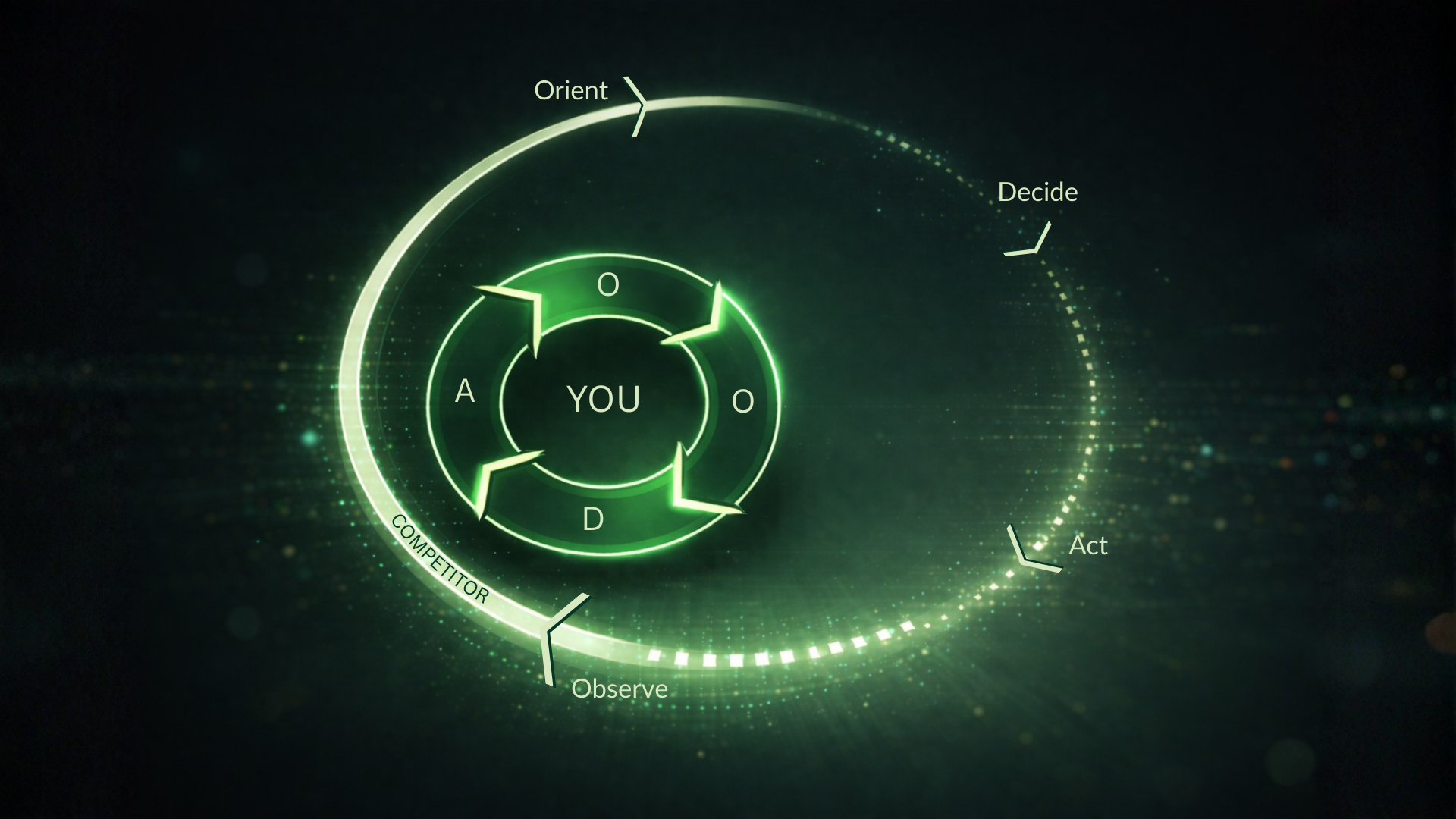
Complete your OODA Loop before your competitor (Image by J Eselgroth with Gen AI)
Decisions are only as good as your ability to make them at the speed of need.
The OODA loop, developed by military strategist John Boyd, remains one of the most durable frameworks for understanding decision advantage. Observe, Orient, Decide, Act. Simple in concept. Brutal in execution. Boyd's insight was that the competitor who cycles through OODA faster doesn't just react quicker. They force the other side into perpetual confusion. If you complete your loop before your adversary finishes orienting, they're always guessing. You've seized the initiative. They're responding to a reality that no longer exists.
This isn't doctrine for fighter pilots. It's the operating logic of 2026.
The Real Failure Mode
Here's what most organizations get wrong: they assume the information-gathering process is fixed. That synthesis takes as long as it takes. That the path from raw data to decision-ready insight can't be meaningfully compressed.
It can. Technology is the nitrous oxide.
GPUs, CPUs, AI, and intelligent automation exist to collapse the loop. Not to generate more reports. Not to build prettier dashboards. To crash the time between a question and an answer. Between signal and synthesis. Between context and decision.
Years ago, I sat with a brigadier general who framed the challenge perfectly. "Jim, when a decision lands on my desk, I have to make it. That's why I have this star. But the reality? I might have 30% of the information I need. And typically zero understanding of the second, third, and fourth-order effects of that decision." He paused. "Wouldn't it be something if I could get to 50%? And maybe 10% visibility into the downstream consequences? That would be phenomenal."
That's the gap. Not late decisions. Decisions made on schedule but with degraded context. The insight arrived too late, or never arrived at all, so intuition filled the void.
When your OODA loop can't keep pace with decision deadlines, you don't postpone the decision. You make it anyway, with partial signal, stale context, or gut instinct standing in for synthesis. That's where decision advantage is won or lost. Not in the quality of the decision itself, but in whether relevant insight was present when the decision had to be made.
Speed doesn't delay action. It determines whether insight shows up in time.
Why OODA Feels Slow
The loop isn't broken. It's stretched.
Observe takes too long because data exists but signal doesn't. Orient requires too much human stitching. Decide waits on synthesis. Act inherits the accumulated delay. Every phase is elongated by manual tasks, analog handoffs, and processes that are digital but not intelligent.
I've seen this firsthand. In 2018, I contributed to a 93-slide executive briefing for a four-star general. My piece was two or three slides. But watching the full effort unfold was revealing. So I ran the numbers.
Total preparation cost: $241,881. Total preparation time: 772 hours, nearly five full work months. Fourteen meetings and dry runs. And the developer-to-bureaucracy ratio? 1:3. For every hour spent creating content, three hours were spent reviewing, vetting, or updating it.
The deck accomplished its goal. It informed leadership. But it was fundamentally a rearview-mirror exercise. Awareness, not action. Insight into what had happened, not what should happen next. Enormous energy devoted to building artifacts of understanding, with little investment in converting those artifacts into decisions.
That's the stretch. Not broken. Bloated.
The Decision Supply Chain
OODA describes the cycle. The Decision Supply Chain describes the infrastructure that makes the cycle fast or slow.
Think of it this way: knowledge alone is inert. A body of knowledge, whether policies, doctrine, market data, or operational history, only becomes useful when it's contextualized. Context transforms raw knowledge into decision-driven data. Decision-driven data enables action. Action produces outcomes. Outcomes feed back into knowledge.
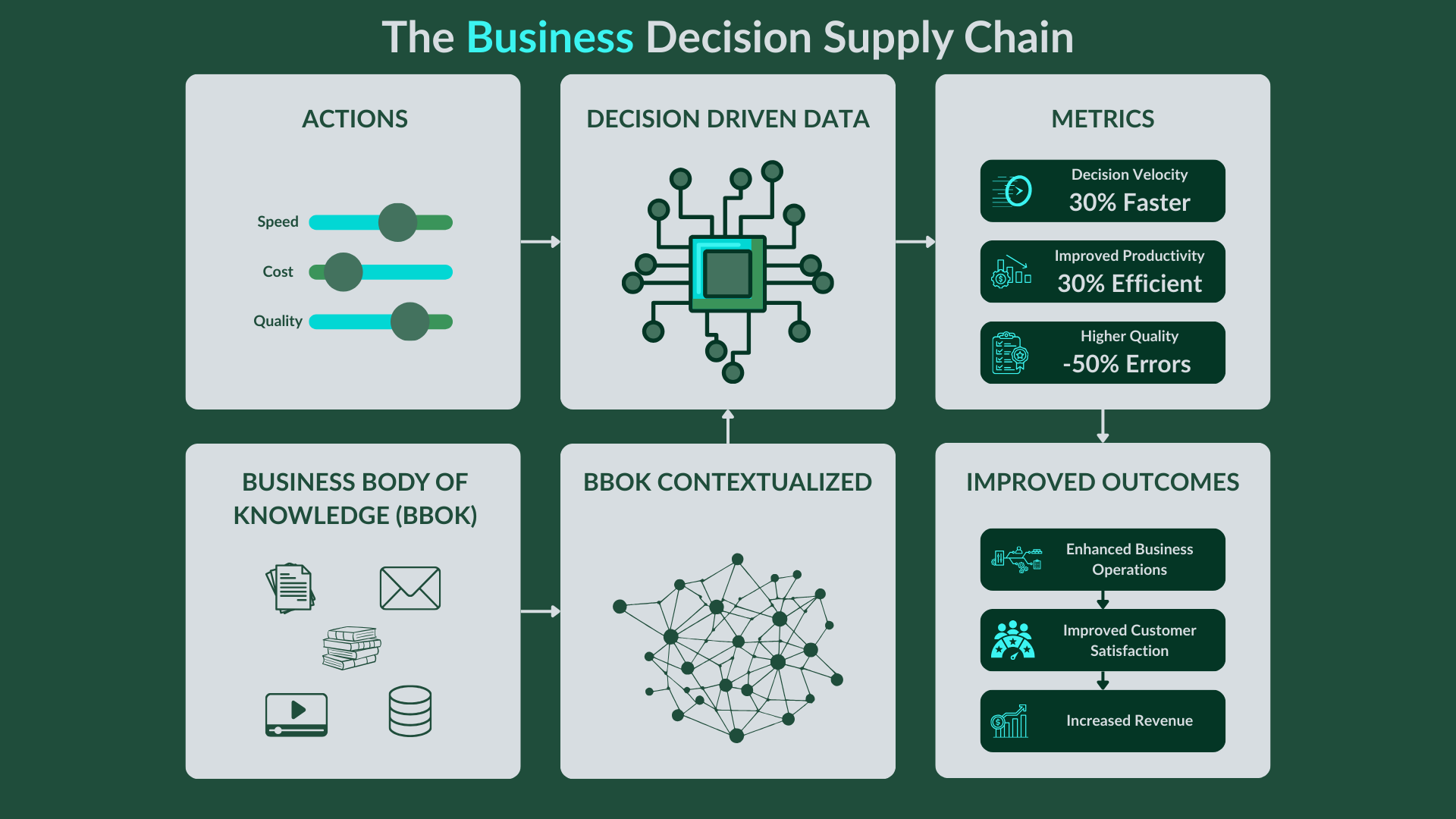
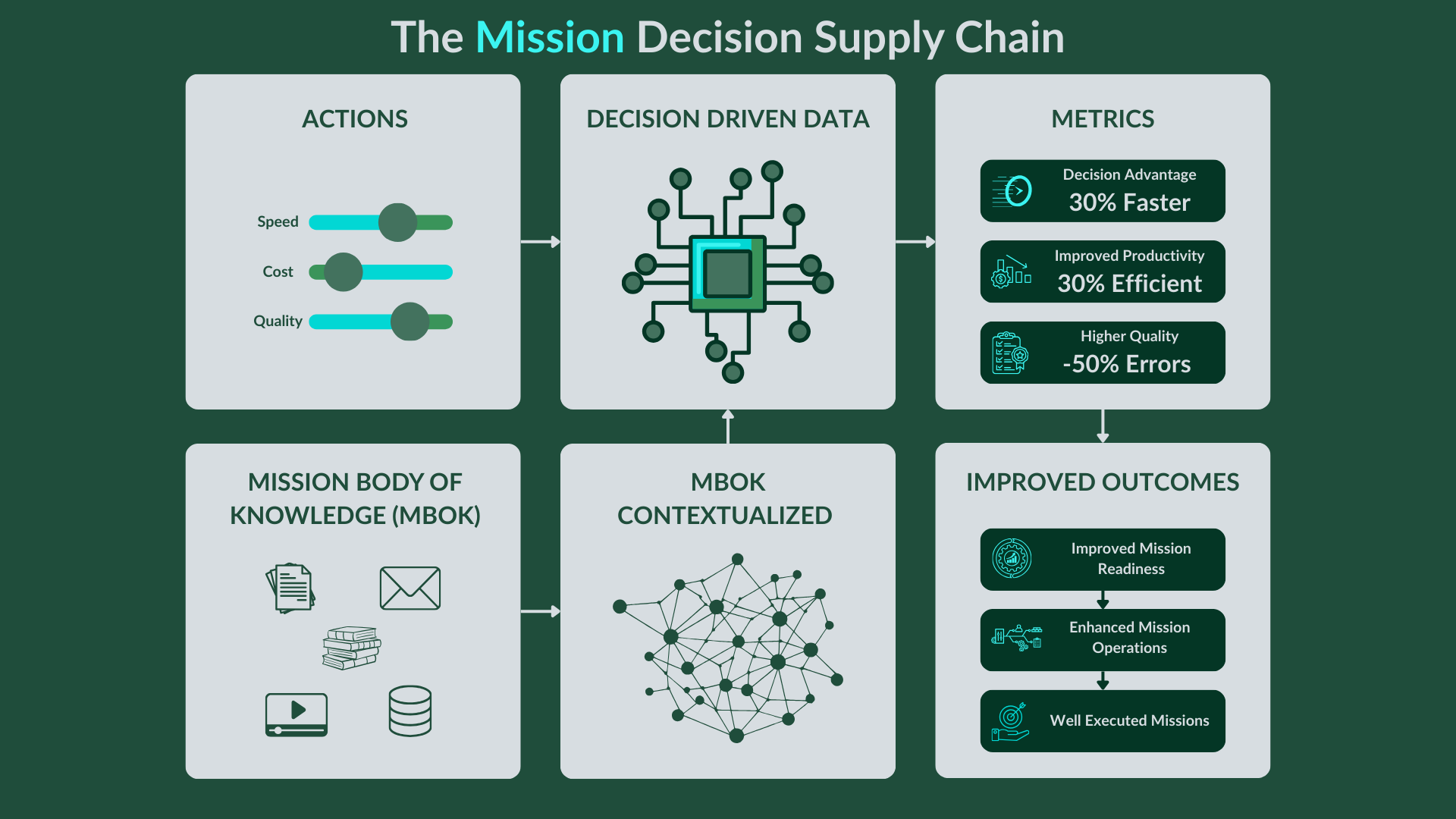
This flow is identical whether you're running a business or executing a mission. Different contexts. Same system.
The supply chain exists whether you design it or not. If you don't own it, friction will. And as General Gordon Sullivan wrote in Hope Is Not a Method, hope is precisely that: not a method. When you don't deliberately design your decision supply chain, you're not just accepting friction. You're placing blind hope where architecture should be.
Most organizations have fragmented supply chains. Data lives in silos. Context is reconstructed manually for every decision. Synthesis depends on individual analysts with institutional knowledge locked in their heads. The result is a loop that stretches with every handoff.
Compressing the Decision Supply Chain is how you compress OODA.
From Violinist to Conductor
Today's leadership model still depends on hands-on synthesis. Leaders trust analysts. Analysts gather and prepare information. Leaders interpret it. Even with dashboards and automation, too much of the violin is still being played by hand.
The shift underway is fundamental. Leaders are moving from players to conductors.
In the emerging model, agents, models, and contextualized bodies of knowledge perform the synthesis. Leaders set intent, constraints, and direction. They don't compile decisions. They conduct them. The orchestra plays. The conductor shapes the performance.
This is augmented intelligence in practice. Machines excel at pattern recognition, correlation, and execution at scale. They compress Observe and Orient into a continuous, living system where context carries forward automatically. Humans remain responsible for intent, judgment, strategy, and accountability. You can accelerate every letter of the OODA loop with technology, but you cannot outsource responsibility.
Technology as a superpower means collapsing time, not decorating delay.
One Process. This Week.
The tools exist. Power Automate. Appian. UiPath. Platform-native AI. If you're in the DoD, you have access to GenAI. The question isn't access. It's adoption.
So here's the challenge for 2026: What is one process you can automate this week to buy back decision time?
Not a transformation initiative. Not a multi-year roadmap. One process. One automation. One hour reclaimed and redirected toward a higher-order decision.
That's how you start finishing your OODA loop first.
Decision advantage isn't about better answers. It's about better timing. Act before they orient, and you're no longer reacting. You're dictating the tempo.