
From Cuts to Clarity: What Efficiency Actually Requires
BLUF: Efficiency without architecture is just speed, and speed without understanding is how you break things that matter.
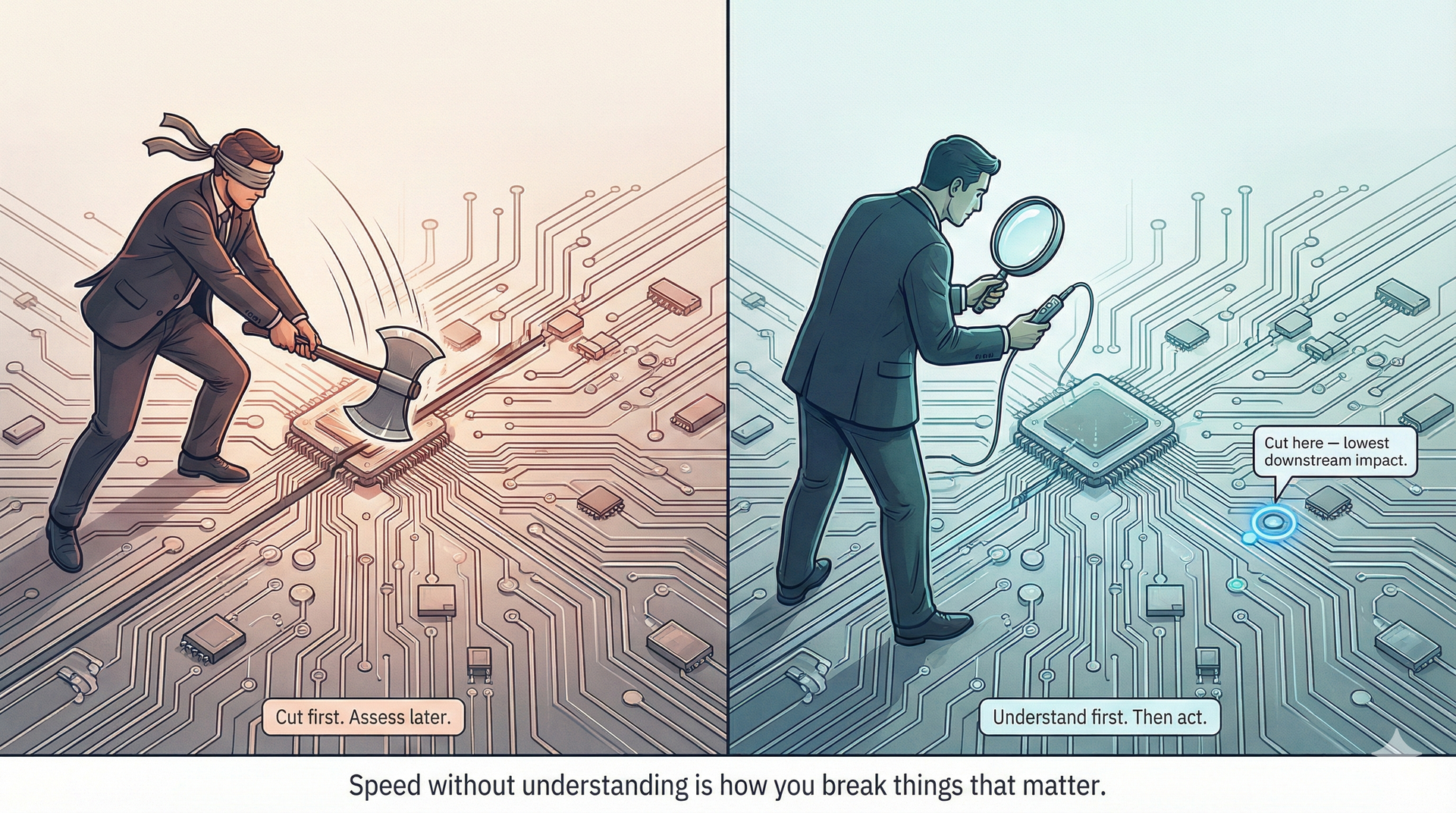
Cutting blindly or cutting with understanding (Image by J Eselgroth with GenAI)
Merriam-Webster defines efficiency as "effective operation as measured by a comparison of production with cost."[1] Oxford frames it as "doing something well with no waste of time or money."[2] My family put it more simply over dinner: accomplishing a task in the fewest steps using the least effort.
All three definitions share a common thread, and it has nothing to do with headcount. Efficiency is about process. It is about how people, policies, processes, partners, and platforms work together to produce an outcome. These five elements, the 5Ps, exist in every organization and every contract. When they are aligned, workflows and value compounds. When one is removed without understanding how it connects to the others, the system does not simply shrink. It fractures in ways that are difficult to predict and expensive to repair.
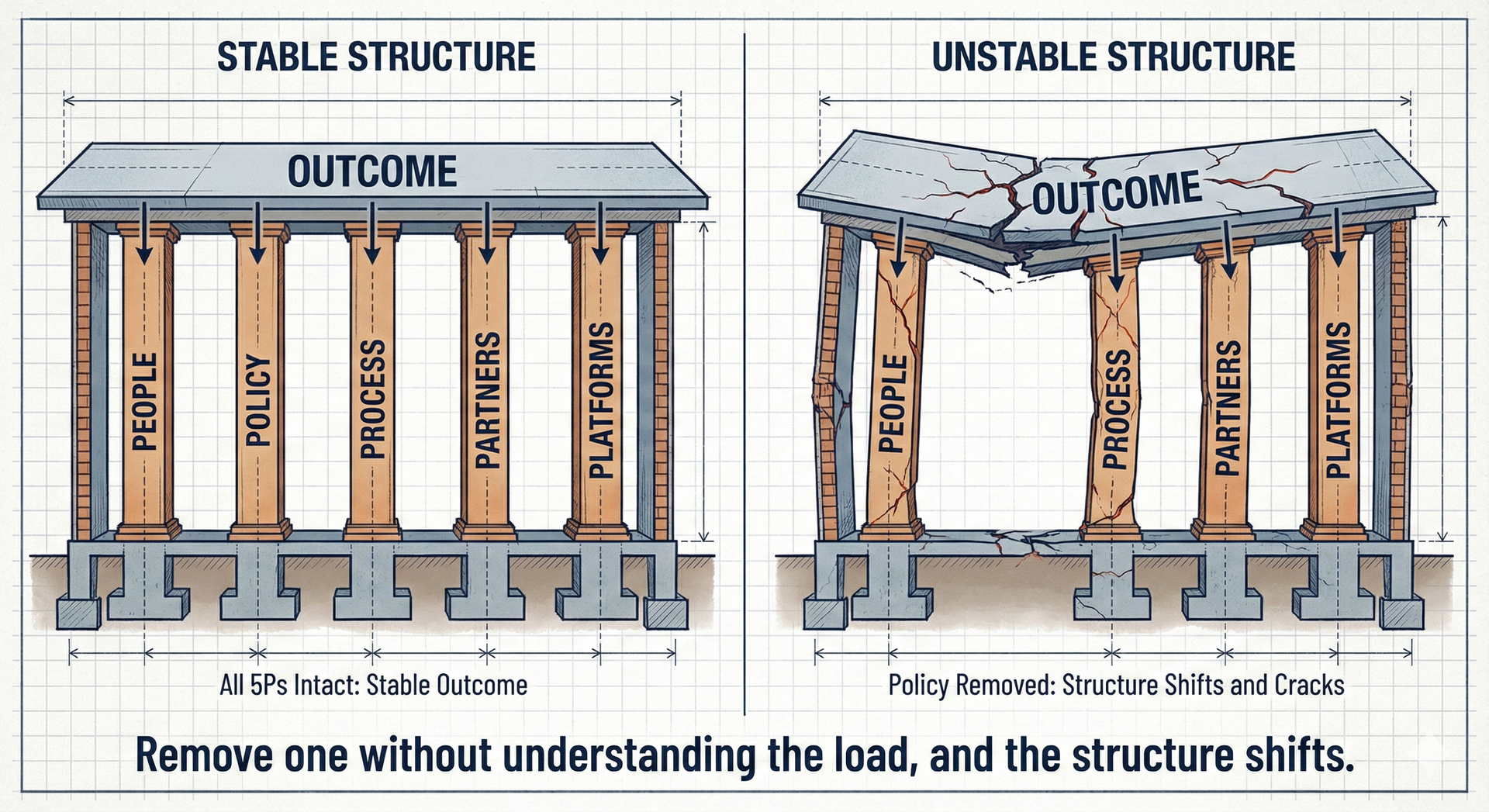
The 5P's and their relationship to delivering outcomes (image by J Eselgroth with Gen AI)
This is where the distinction between cutting and improving becomes critical. Removing a contract is not the same as improving efficiency. Cutting staff is not the same as optimizing a process. If you do not understand how a contract interfaces with the larger organization, you cannot know what you are actually doing when you cancel it. The 5Ps are not line items. They are load-bearing walls.
The DOGE Approach
In 2025, the Department of Government Efficiency launched a rapid campaign of contract cancellations and workforce reductions across federal agencies. The scale was unprecedented. Contracts worth billions were terminated. Entire program offices went dark. Thousands of federal employees and contractors found themselves suddenly without work, many with little warning and less explanation.
I was among them. Twice.
Within a span of months, I lost two executive roles, both directly traceable to DOGE-driven contract cancellations at agencies my employers supported. The first came 45 days into a new position as Chief Technology and AI Officer. The second arrived around month five as SVP of Technology and Innovation at a larger firm. In both cases, the message from leadership was the same: the cuts upstream had eliminated the revenue that funded my role.
If you worked in or around federal contracting this year, some version of this story is probably familiar. You may have lived it yourself, watched colleagues pack their desks, or felt the ripple effects in your own organization. The stated goal was efficiency: reduce spending, eliminate waste, and move fast. The execution was blunt force applied at scale.
The Missing Variable
I hold no grudge toward either company that let me go. They made hard calls under real pressure, and I understand why. I am even somewhat empathetic about what DOGE was trying to accomplish. Driving change at scale, under time constraints, with incomplete information is brutally difficult.
Research confirms what most leaders already know intuitively. Cognitive constraints shape how we make decisions under uncertainty, and models of decision-making should account for the pervasive limitations of human cognition.[3] When stress compounds that uncertainty, people default to simpler heuristics and faster action, often at the expense of nuance.[4] The interplay between stress and decision-making is complex, influenced by timing, context, and individual differences.
The problem is not will. The problem is architecture.
When the system is too complex to model, you cut and see what happens. It may feel like the only viable option. But that is a symptom, not a strategy. Imagine if DOGE had access to a tool that could answer a simple but powerful question: where is the best utilization of our taxpayer dollars? A system capable of modeling how actions connect to outcomes. How a contract cancellation ripples through the 5Ps of an agency. How strategy and reality align, or fail to.
Such a tool might have enabled more precision. It might have surfaced alternatives that no one had considered. It might have changed what got cut and what got protected. Without that architecture, rapid action becomes the only path forward.
But here is the opportunity hidden in that constraint: we can build it. I know because I have done it before.
I Was Doing Decision Intelligence Before I Knew It
In 2015, the Air Force handed me a version of the same problem.
We had just stood up the Air Force Installation and Mission Support Center, and the commander wanted to centrally manage all small arms firing ranges across the enterprise. This had never been done in USAF history. The question seemed simple enough: if we had a dollar to spend, where should we spend it? But then came the harder questions. Do we have a prioritized list? If we spend that dollar, what are the second, third, and fourth-order effects of that decision?
We did not have answers. So we built them.
We started with Security Forces data, then expanded to Civil Engineering, Finance, Human Capital, and beyond. We deconstructed the problem by focusing on the stakeholders affected by range outcomes. We expanded perspectives and added data sources. When the AFIMSC Commander saw early results, she asked about range capacity, which unlocked an entirely new layer of context we had not anticipated. Each question led to better questions, and each answer revealed more of the system.
By May 2018, we delivered a 30-year, $954 million strategy for right-sizing every firing range across the globe. It was the first asset management approach of its kind in the Air Force. I did not call it Decision Intelligence at the time, but that is exactly what it was: connecting actions to outcomes, modeling consequences, and putting leaders in a position to make informed choices before committing resources.
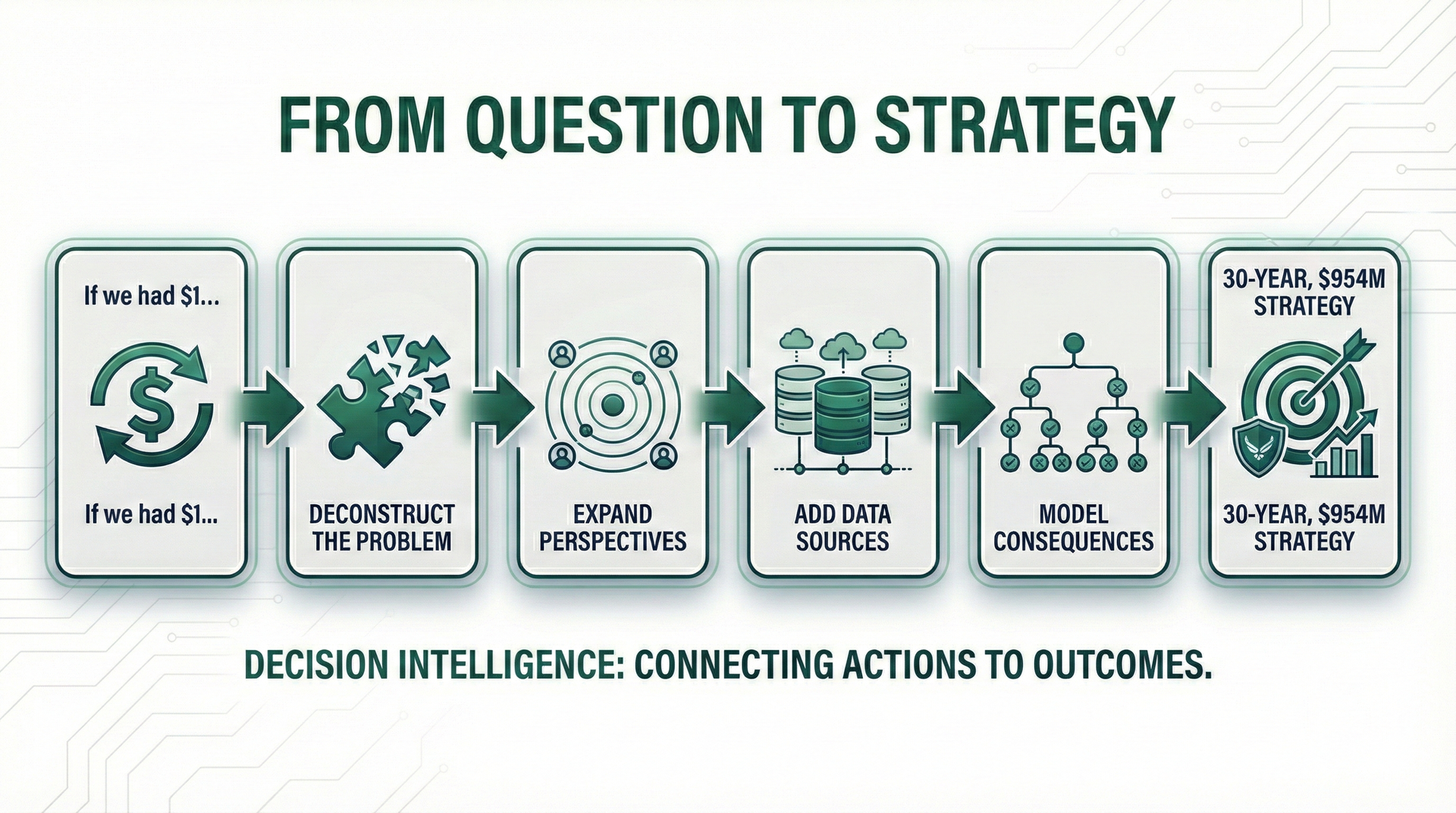
From 1 Question to improving an asset class for years to come (Image by J Eselgroth with Gen AI)
Efficiency Redefined
Last year, I introduced the Digital Efficiency Matrix, a 3x3 framework that maps digital maturity against operational efficiency.[5] The insight was straightforward but important: the destination is not "digital." The destination is intelligent. An intelligent enterprise does not just digitize its processes. It understands them. It models them. It simulates outcomes and anticipates consequences before committing resources.
The path from today to that destination is Intelligent Transformation, and the engine that powers it is Decision Intelligence.
But reaching that destination requires more than technology. It requires disciplined attention to the 5Ps: People, Policy, Process, Partners, and Platforms. Each must be assessed. Each must align. Technology alone cannot carry you there. The 5Ps are the connective tissue that determines whether a transformation holds together or falls apart under pressure.
Decision Intelligence gives leaders visibility into consequences before they decide. It makes complexity manageable by surfacing the relationships between actions and outcomes. It does not replace accountability. It accelerates the ability to exercise accountability wisely, with evidence rather than intuition alone.
Why Chiron AI
Both layoffs gave me the same gift: clarity.
I had always wanted to build Chiron AI, but I did not know when or how to make the leap. This year answered that question for me. Each role gave me R&D momentum and sharpened my thinking about what leaders actually need. Each disruption removed another reason to wait. Sometimes the path forward only becomes visible when the path you were on disappears.
Our mission is simple: turn strategy into reality. We are building the apparatus that lets decision-makers ingest information, understand context, and model consequences at the speed of relevance. In the age of generative AI, we cannot outsource accountability. But we can equip leaders with the tools to make decisions that stick, decisions grounded in an understanding of what will happen next.
Looking Ahead
Next year, we move from concept to capability. The work is underway, and I am not ready to say more just yet. But the direction is clear, and the urgency is real.
Efficiency is not speed alone. It is precision. It is foresight. It is understanding what you are doing before you do it, and documenting why you made the choice you made.
As you enter 2026, consider the decisions you will face. What complexity will demand clarity? What choices would benefit from modeling and simulation before you commit? What second and third-order effects are you currently unable to see?
The tools are within reach. Sometimes the architecture starts with a whiteboard and the right people in the room. Sometimes it starts with a conversation about what you wish you understood before you acted. The question is not whether you have the resources to begin. The question is whether you will.
Sources
[1] Merriam-Webster. "Efficiency." Merriam-Webster.com Dictionary. https://www.merriam-webster.com/dictionary/efficiency
[2] Oxford University Press. "Efficiency." Oxford Learner's Dictionaries. https://www.oxfordlearnersdictionaries.com/definition/american_english/efficiency
[3] Lebiere, C., & Anderson, J. R. (2011). Cognitive constraints on decision making under uncertainty. Frontiers in Psychology, 2, 305. https://doi.org/10.3389/fpsyg.2011.00305
[4] Sarmiento, L. F., Lopes da Cunha, P., Tabares, S., Tafet, G., & Gouveia Jr, A. (2024). Decision-making under stress: A psychological and neurobiological integrative model. Brain, Behavior, & Immunity - Health, 38, 100766. https://doi.org/10.1016/j.bbih.2024.100766
[5] Eselgroth, J. (2024). The Unending Quest for Efficiency: Navigating Beyond Digital Transformation. Chiron AI. https://www.chironai.io/the-unending-quest-for-efficiency-navigating-beyond-digital-transformation
