
Better Decisions Don’t Start with More Data
BLUF | Insight comes from the intersection of the right data and multiple perspectives, not from either alone.
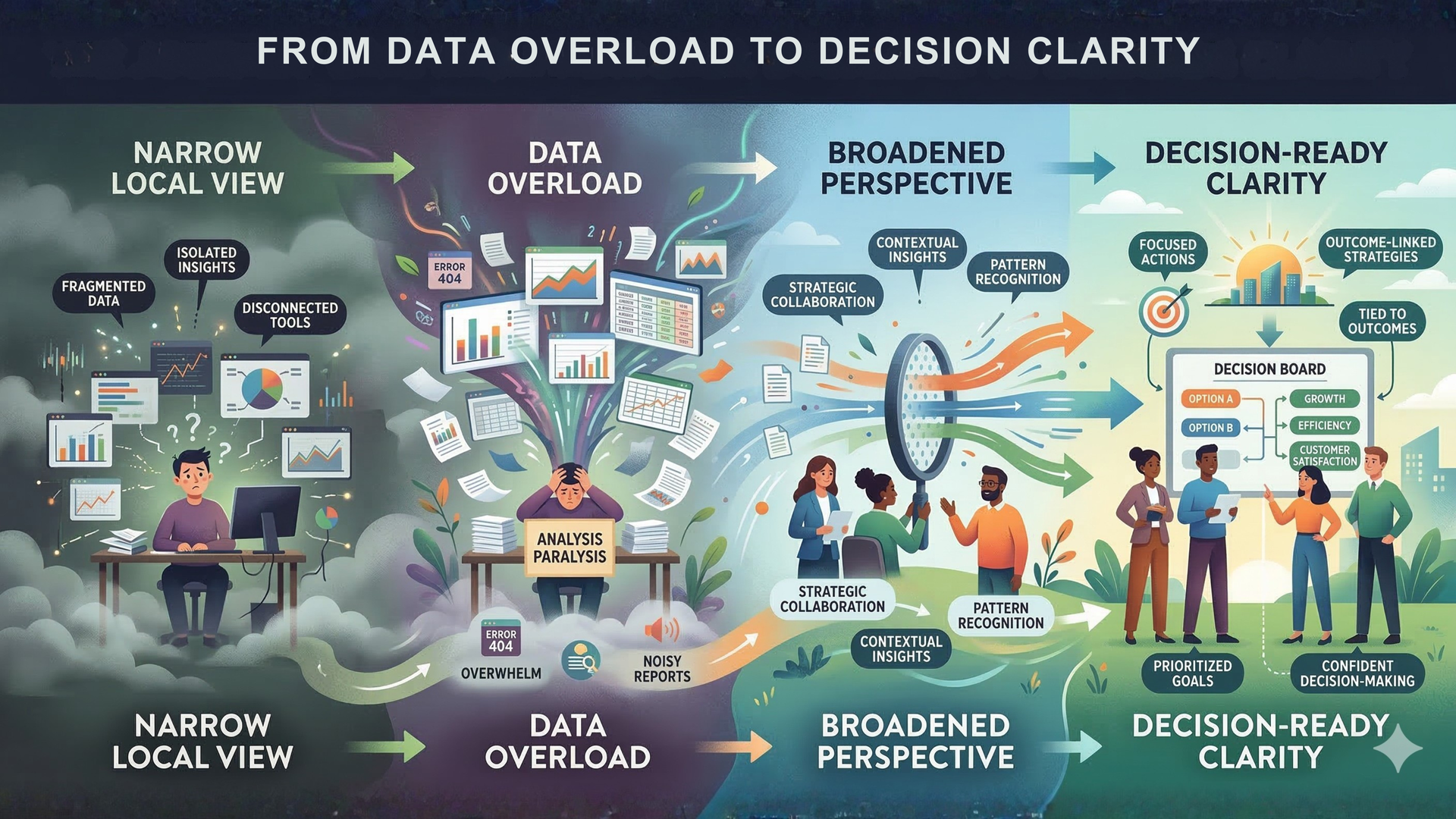
More data does not produce better decisions. Better questions do.
That distinction matters. The federal government has invested heavily in the machinery of data-driven decision making. Agencies have hired Chief Data Officers. The Evidence Act of 2018 set new expectations for how data supports policy. Open data plans, performance reviews, customer feedback loops, and AI governance frameworks now operate across dozens of agencies.
The infrastructure is real. The results are uneven.
Teams accumulate dashboards, reports, models, and metrics. They still struggle to answer basic operational questions. Volume rises. Decision confidence does not.
Recent federal guidance signals a shift. OMB’s 2025 Phase 2 Evidence Act guidance treats data maturity as a governance challenge, not a collection target. It calls for systematic approaches to data access, inventories, quality, and usability [1]. OMB’s 2025 memo on broadening participation states that meaningful engagement is foundational to informed government decision-making [2]. OMB Circular A-11 Section 260 defines data-driven reviews as a management routine proven to produce better results [3].
The pattern is clear. Washington is moving past “get more data” toward “govern data well, broaden perspective, and connect both to outcomes.”
That is exactly what the Data Driven Matrix describes.
The Two Axes That Shape Insight
The matrix rests on two dimensions: data maturity and perspective.
The vertical axis represents data maturity. At the bottom sits the data an organization currently holds. Moving upward represents data that could exist but has not been collected, integrated, or made usable. Maturity is not volume. It is structure, quality, accessibility, and fitness for purpose. OMB’s Evidence Act guidance reinforces this. It emphasizes timeliness, completeness, consistency, accuracy, and availability as markers of real data readiness [1].
The horizontal axis represents perspective. Every analysis passes through a lens. That lens is shaped by training, role, incentives, and institutional habit. Teams with similar backgrounds ask similar questions. They validate similar assumptions. The result is analytical tunnel vision that feels rigorous because everyone agrees.
OMB’s participation guidance names the antidote directly. Broader engagement gives agencies greater insight into the lived experiences and perspectives of communities [2]. That is not a soft add-on. It is how the questions improve.
Better perspective sharpens the questions. Better questions reveal what data actually matters. The intersection of these two axes produces four organizational states.
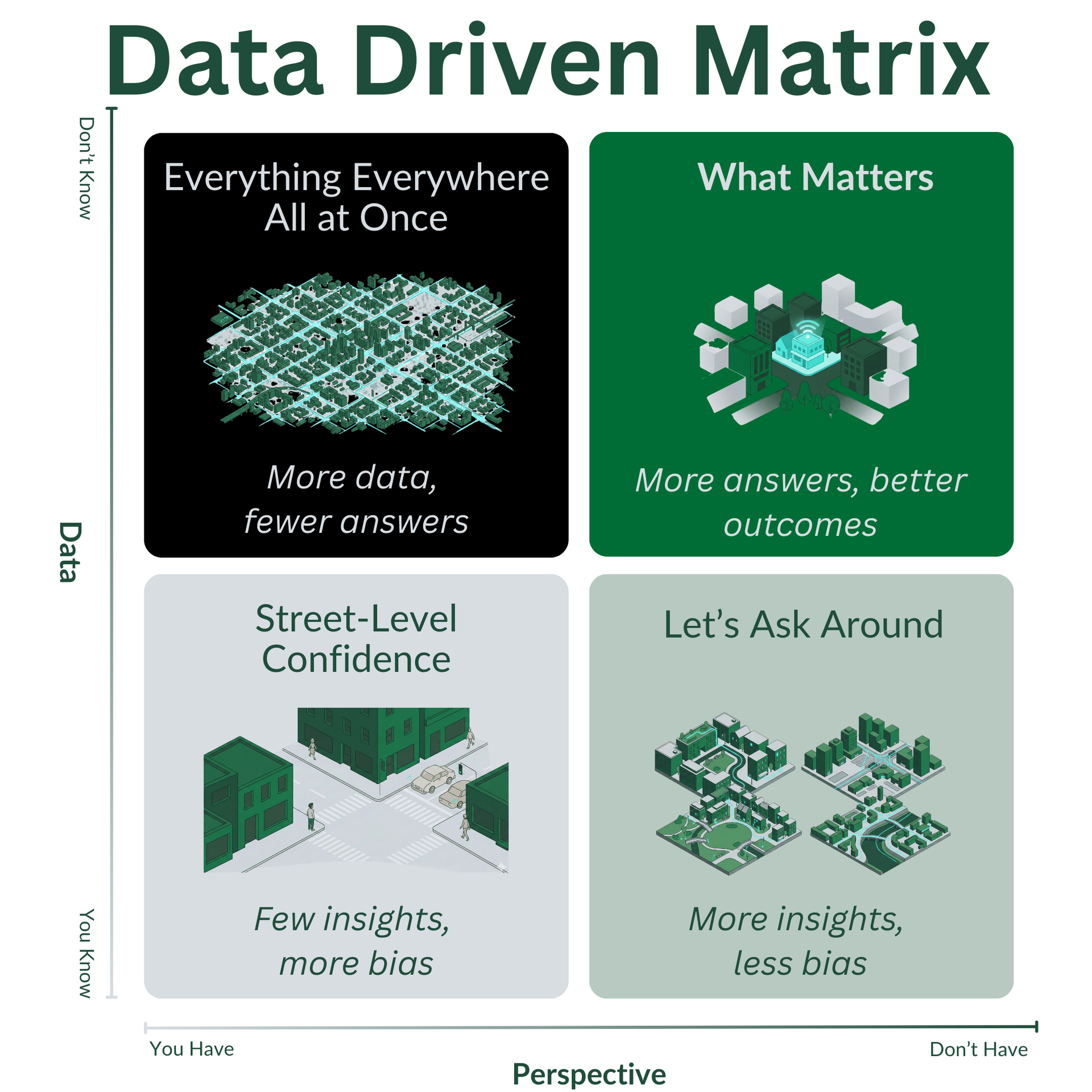
Figure 1: The Data Driven Matrix
Street-Level Confidence
Few insights, more bias
Most teams start here. They use the data they have. They rely on the perspectives already in the room. The work is sincere. The scope is narrow.
It is like standing on one street corner and explaining how the whole city works. You notice what passes in front of you. You build a theory. Your assumptions harden faster than your understanding.
This quadrant produces confidence before it produces clarity.
Everything Everywhere All at Once
More data, fewer answers
When confidence cracks, teams reach for more data. New systems connect. Dashboards multiply. Warehouses expand. The environment grows dense and expensive.
If perspective has not changed, additional data amplifies noise. Collection outpaces interpretation. The organization becomes better at gathering inputs without becoming better at using them.
Federal guidance points to the corrective. A-11 Section 260 does not call for reviewing everything. It focuses on a limited set of performance priorities, using recent evidence to diagnose problems and adjust course [3]. The lesson: disciplined focus beats maximal visibility.
This is where most “data-driven” efforts stall.
Let’s Ask Around
More insights, less bias
The breakthrough comes from broadening perspective, not broadening collection.
Operators explain how the process actually works. Policy experts surface legal constraints. Customers describe what the system feels like from the receiving end. Cross-functional partners challenge definitions that had gone unquestioned.
The result is not more opinions. It is better framing.
OMB’s participation memo reinforces this move. Public input shapes priorities and leads to more responsive policies and programs [2]. A-11 Section 280 makes a parallel case. It treats customer feedback as central to service improvement and calls for actionable data that informs design decisions [3].
This quadrant reveals something important. Many decision problems are not informational. They are interpretive. Fix the frame, and the data search sharpens.
What Matters
More answers, better outcomes
Broader perspective now guides targeted data use. The organization stops collecting everything. It starts answering the right question with the right evidence, in time to affect a real decision.
A-11 Part 6 defines actionable information as data that is accurate, timely, relevant, and presented in the right format for the user [3]. Section 290 ties evidence-building to learning agendas, priority questions, and the use of results in decisions [3].
This is the quadrant where “data driven” becomes too small a phrase. The organization is decision-oriented. It pursues decision relevance, not data completeness.
The goal is not more dashboards. The goal is better outcomes.
Moving Across the Matrix
Most organizations start on the left. They work with limited data and limited perspective, or they compensate by adding data without changing how they think. Progress comes from moving diagonally. Expand perspective. Improve data quality and relevance together. Structured decision processes make that movement deliberate. The FORGED framework sequences the work:
• Frame clarifies the decision and its context.
• Organize establishes trusted data, definitions, and boundaries.
• Refine separates signal from noise.
• Generate produces decision-ready artifacts.
• Engage tests interpretation with stakeholders.
• Deploy embeds insight into operational workflows.
The sequence matters. It does not begin with “gather everything.” It begins with clarity. Then structure. Then interpretation. Then validation. Then action.
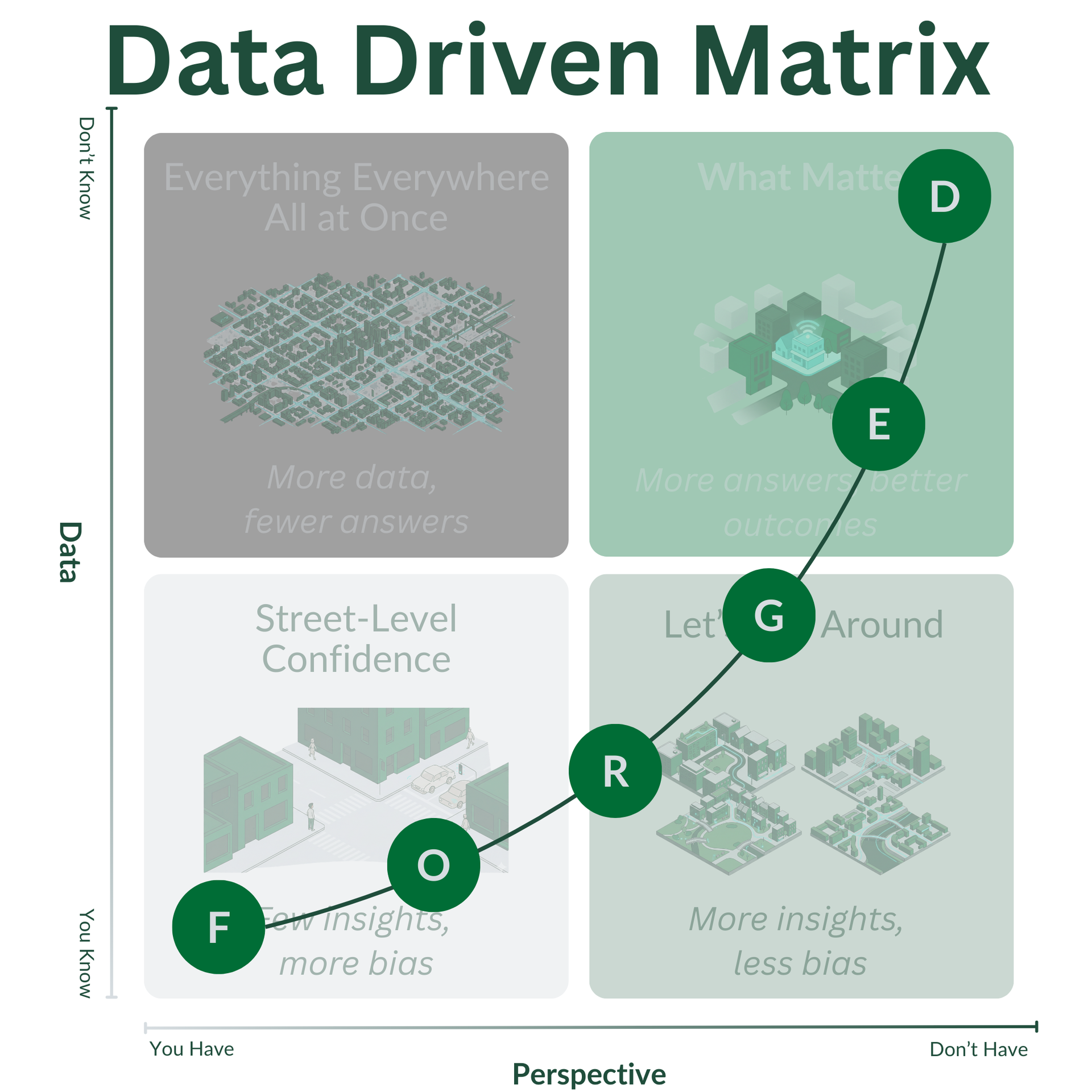
Figure 2: The FORGED Process Mapped to the Data Driven Matrix
The same logic now appears in federal AI guidance. OMB’s 2025 AI memo directs agencies to pair innovation with governance and public trust. It calls for risk management on high-impact AI and feedback from end users and the public [4]. Even in the newest policy domain, the message holds: better tools still require better judgment and broader perspective.
Why This Matters
In government, bad decisions are never abstract. They become delayed services. Misallocated funding. Weak oversight. Missed mission outcomes.
The real challenge is not becoming more data driven. It is becoming more decision capable.
Data without perspective produces noise. Perspective without evidence produces untethered intuition. Durable decision advantage comes from combining both on purpose.
That is the journey the Data Driven Matrix maps. From Street-Level Confidence to What Matters. Not through more data alone, but through better questions, broader perspective, and evidence that is usable when decisions must be made.
To see where your organization sits on the Data Driven Matrix, try the self-assessment at [link].
References
[1] Office of Management and Budget, M-25-05: Phase 2 Implementation of the Foundations for Evidence-Based Policymaking Act of 2018 — Open Government Data Access and Management Guidance, January 2025.
[2] Office of Management and Budget, M-25-07: Broadening Participation and Engagement, January 2025.
[3] Office of Management and Budget, OMB Circular A-11: Preparation, Submission, and Execution of the Budget, August 2025. (Sections 260, 280, 290, and Part 6.)
[4] Office of Management and Budget, M-25-21: Accelerating Federal Use of AI through Innovation, Governance, and Public Trust, February 2025.
