
Digital Transformation Is Dead! Welcome Intelligent Transformation.
BLUF | Digital Transformation gave us tools. Intelligent Transformation gives us wisdom. The future isn’t about doing more digitally; it’s about deciding more intelligently.

Most organizations have spent the past decade chasing Digital Transformation. We’ve modernized systems, moved to the cloud, automated workflows, and digitized many processes that once lived on paper. We did what we needed to do… and it sort of worked.
But now, it’s time to move on. Digital Transformation isn’t failing. It’s finished. It’s run its course.
The Evolution | From Digitizing to Thinking
When Digital Transformation began, it was the right response to the problems of the time. We had paper-heavy workflows, disconnected systems, and data locked inside silos. We saw the internet, cloud computing, and automation as the tools that could finally pull us forward.
So we digitized. We turned forms into fields, meetings into dashboards, and records into databases. We became faster, more efficient, and better connected. It was exactly what we knew how to do, based on what we knew at the time. But transformation doesn’t stop when technology changes, it evolves when our understanding changes.
Today, in 2025, the boundary of “digital” has been reached. We can automate almost anything, but that doesn’t make us more intelligent. We’ve connected every system, yet we still struggle to connect decisions. The real challenge isn’t doing things faster it’s doing the right things smarter.
We’ve entered a new phase. The opportunity is to up our game moving from digitizing processes to "intelligizing" systems. Even after a decade of investment, only about 48% of digital transformation projects succeed a clear sign that the digital era has reached a plateau. Coherent Solutions, 2025
Defining Intelligent Transformation
Intelligent Transformation is about combining human judgment, machine learning, and contextual data creating systems that are adapting, learning, and improving. It’s the shift from activity to intelligence from dashboards that report the past to ecosystems that anticipate the future.
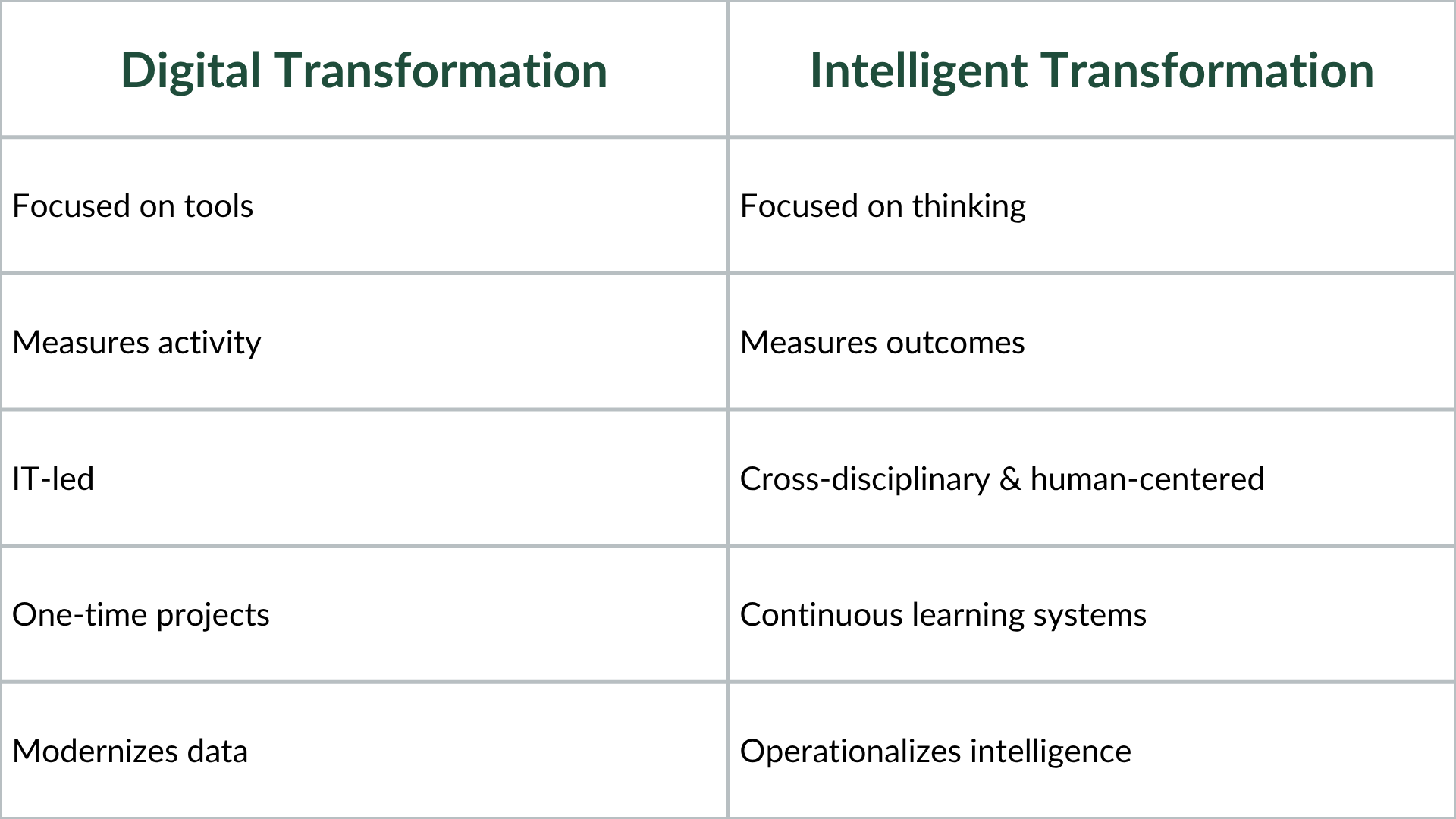
Comparing Digital to Intelligent Transformation (by J Eselgroth)
Where Digital Transformation built efficiency, Intelligent Transformation builds advantage.
Digital was about doing things digitally. Intelligent is about deciding things intelligently.
The rise of AI adoption underscores this shift, as an example the IT and telecom sectors alone report a 38% AI adoption rate and forecast over $4.7 trillion in gross value creation by 2035. Netguru, 2025
A Framework | The APEX Process
To help organizations move toward that next level, I use a framework called APEX, a four-stage process describing how to evolve from wherever you are on the transformation continuum toward the upper-right quadrant, where efficiency and intelligence meet. What's the efficiency matrix? Learn more in The Unending Quest for Efficiency blog article.
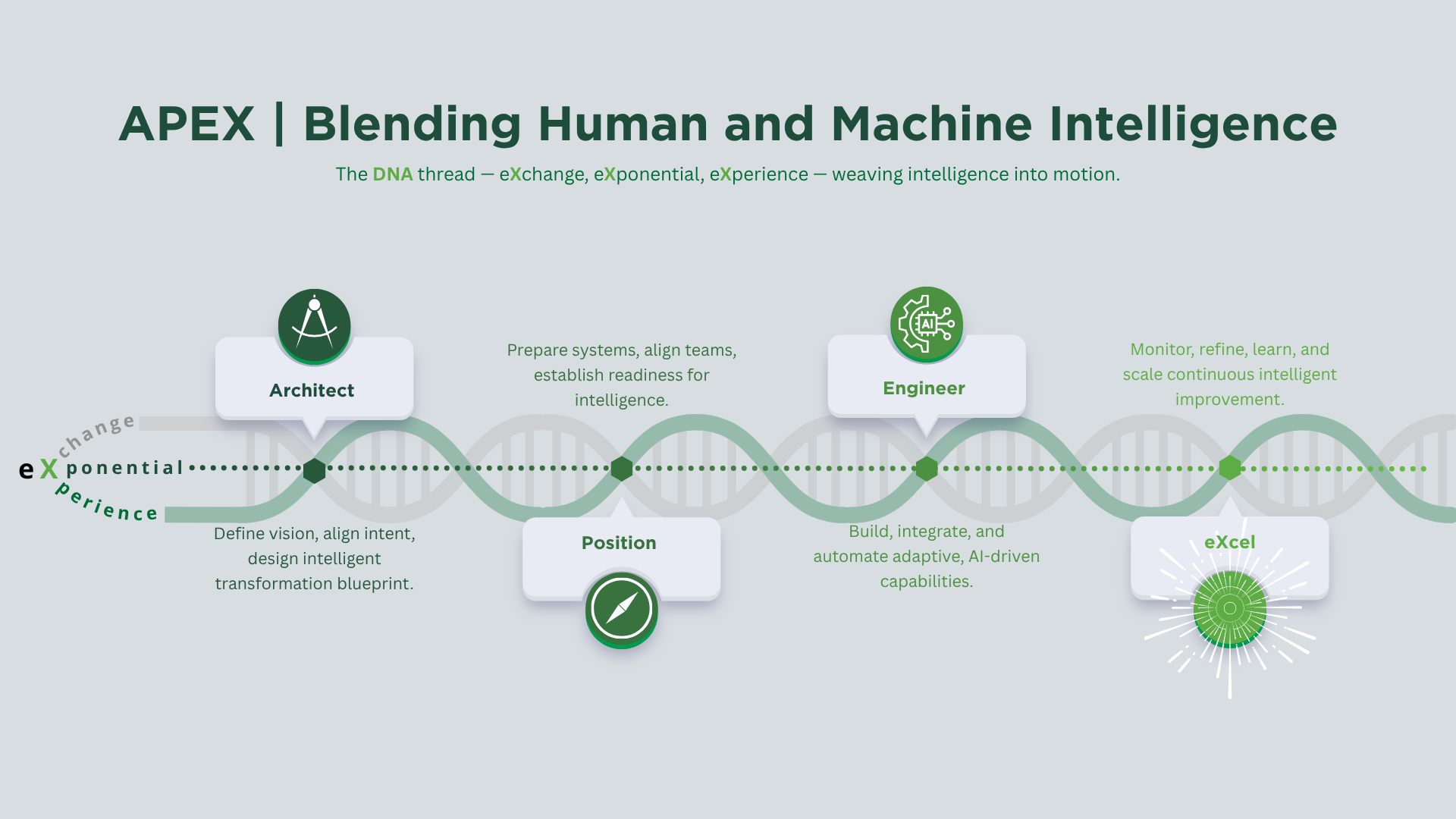
The APEX Process | Where insight learns. And learning becomes Advantage. (by J Eselgroth)
Each of the four stages, Architect, Position, Engineer, and eXcel, represents a disciplined action that builds toward Intelligent Transformation. What connects and empowers them all is the X, powered by the three E’s:
- eXchange | the flow of data, context, and learning between systems and people.
- eXponential | the compounding improvement that occurs as intelligence scales through feedback and adaptation.
- eXperience | the human element that guides, governs, and trusts the system.
Together, these create the multiplier effect that transforms APEX from a process into a living framework for continuous intelligence.
- Architect | Define intent, context, and purpose. Align the 5Ps (People, Policy, Process, Partners, and Platforms) to create an intelligent blueprint. This is where vision meets structure and where transformation gains clarity of direction. The Exchange begins here as insight and intent inform the design.
- Position | Set the conditions for success. Translate the blueprint into readiness. Align teams, data, and technology to operate intelligently. Positioning is both strategic and systemic; it ensures governance, capability, and culture are in place before scaling. The Experience element ensures that human context and capability remain in constant dialogue as readiness evolves.
- Engineer | Build with precision and intelligence. Activate the design through AI, automation, and cloud-native architectures. This is the moment when insight becomes capability, when systems learn, adapt, and deliver real-time decision support. Here, the Exponential effect accelerates learning, embedding signals from feedback loops into operations.
- eXcel | Sustain and scale. Monitor, refine, and improve through feedback loops that turn data into insight and insight into continuous learning. Excel transforms transformation itself into a living, evolving capability. The three E’s operate together, multiplying impact as knowledge, trust, and performance expand.
Architect with intent. Position with intelligence. Engineer with precision. eXcel with purpose. All powered by the X, the eXchange, eXponential, and eXperience that drive Intelligent Transformation. That is the rhythm of Intelligent Transformation.
Why It Matters Now
Every organization sits somewhere on the 3×3 matrix of digital maturity and efficiency. Some are modernized but inefficient. Others are efficient but lack intelligence. Many are stuck in the middle, busy but blind. For instance, a 2025 McKinsey report shows only
28% of organizations have effectively embedded generative AI into business processes, proof that most are still bridging the gap between experimentation and integration
McKinsey, 2025.
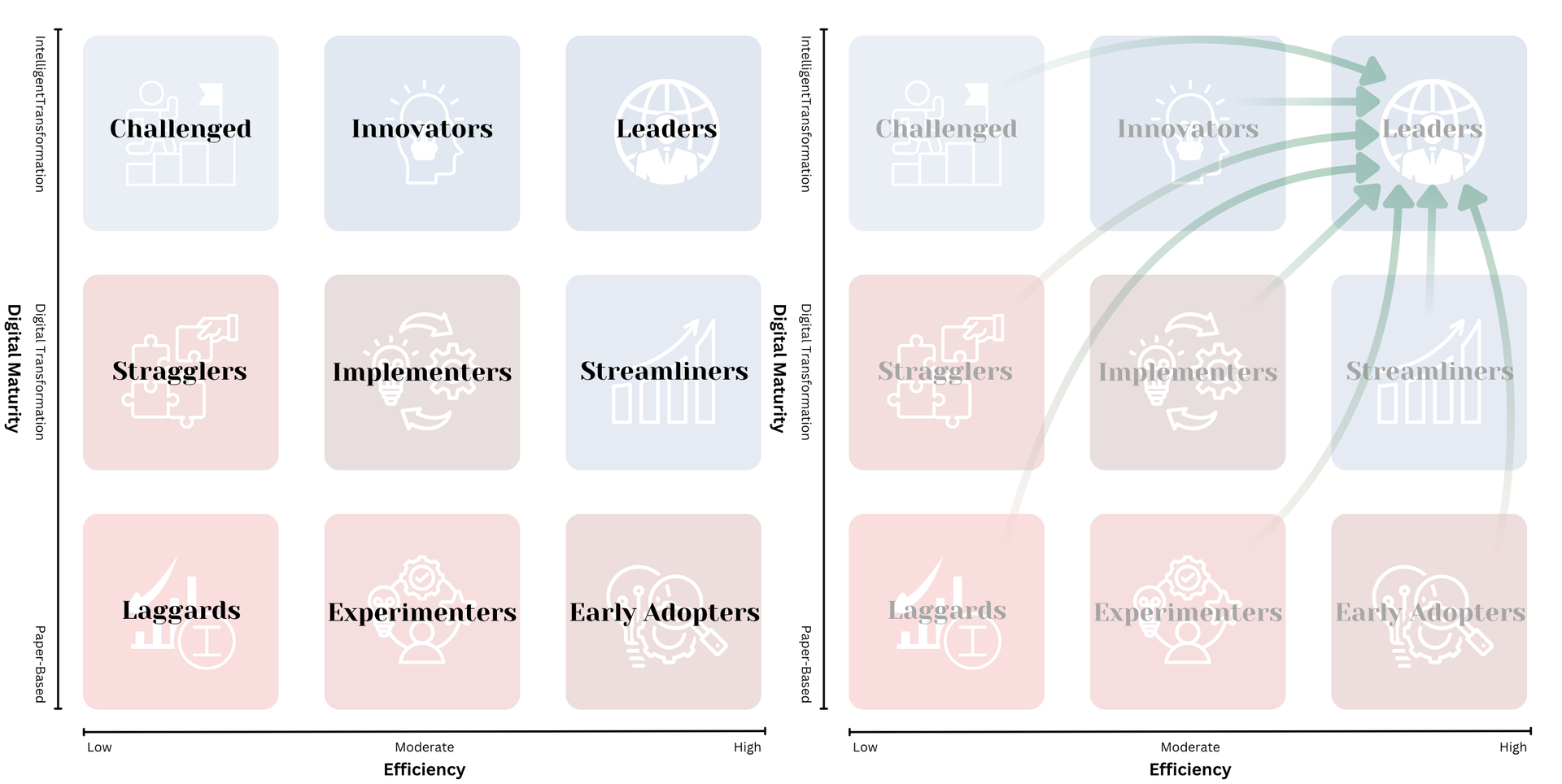
The Digital Efficiency Matrix (left). Your nonlinear journey to being a leader (right) (image by J Eselgroth)
The good news: Intelligent Transformation isn’t linear. You don’t have to finish “digital” before starting “intelligent.” You can begin from any point (e.g. legacy, cloud, or hybrid) as long as you’re willing to connect actions to outcomes.
APEX helps organizations pivot from any position toward that upper-right quadrant, where systems are learning, decisions are accelerating, and leadership regains time for what matters most: judgment, context, and impact.
The Future | From Awareness to Advantage
Digital Transformation gave us tools. Intelligent Transformation enables us to gain wisdom. The organizations that win this decade won’t just be digital, they’ll be decisive. They’ll know how to turn information into action, how to embed learning into every decision, and how to move faster with confidence.
