
GenAI in Action: 5 Steps to Move from Adoption to Advantage
BLUF | Turning GenAI pilots into scalable, trusted systems enhancing human productivity and organizational intelligence.
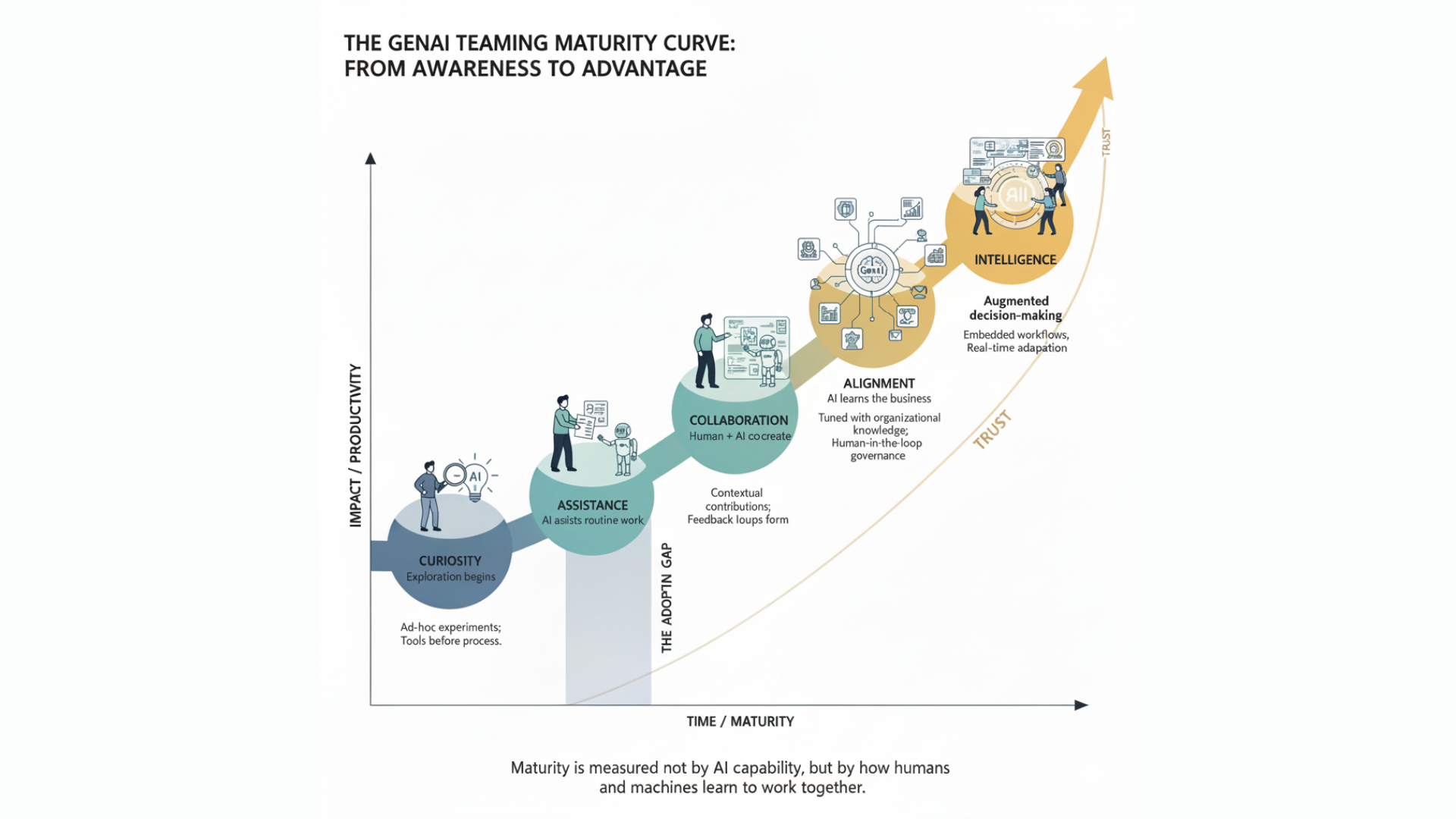
From Knowing to Doing
Most organizations have already met GenAI, but few have learned how to work with it. Across both public and private sectors, pilots are everywhere. Tools are multiplying. Yet measurable progress remains limited.
The challenge isn’t awareness. It’s application.
Real GenAI advantage comes when experimentation gives way to execution, when structure, purpose, and people align to make intelligent transformation possible.
Last time, in GenAI at Work: 5 Observations on Overcoming the Adoption Gap, I focused on what I’ve seen inside organizations wrestling with adoption. This piece builds on those lessons and shifts the lens from observation to action, from identifying patterns to creating progress.
Every successful transformation I have seen shares one truth. It doesn’t start with technology. It starts with structure.
That structure is captured in the 5Ps of Intelligent Transformation: People, Policy, Process, Partners, and Platforms. They form the foundation for every change initiative and frame how each of the five steps ahead takes GenAI from pilot to performance.
Because the goal isn’t to deploy GenAI everywhere. It’s to deploy it intelligently, in ways that strengthen how people think, decide, and deliver.
Step 1: Define the Work Before the Tool
Don’t automate confusion. Understand it first.
Every organization has hidden knowledge locked inside policies, workflows, and decisions. The first step toward intelligent transformation is documenting that knowledge so you can see where GenAI fits and where it doesn’t.
This is where the 5Ps come in. They reveal how people interact with policies, how processes depend on partners, and how platforms enable or constrain the mission.
When you map your As-Is and define your To-Be through the 5Ps lense, you create a clear blueprint for transformation. That clarity feeds your Business Body of Knowledge (BBoK), the living record of how your organization works. It becomes the foundation that makes GenAI relevant, contextual, and trusted.
Step 2: Pair People and AI Intentionally
Match the intelligence to the task and center people in the middle of it. Not every problem needs the same kind of intelligence. Some tasks require precision and control; others need creativity and exploration.
Think of this as a triangle of capability:
- On the left side is deterministic AI | predictable, rule-based systems handling structured, repeatable work.
- On the right side is non-deterministic AI | adaptive, generative systems interpreting context and create new possibilities.
- At the top sits people | providing direction, judgment, and validation.
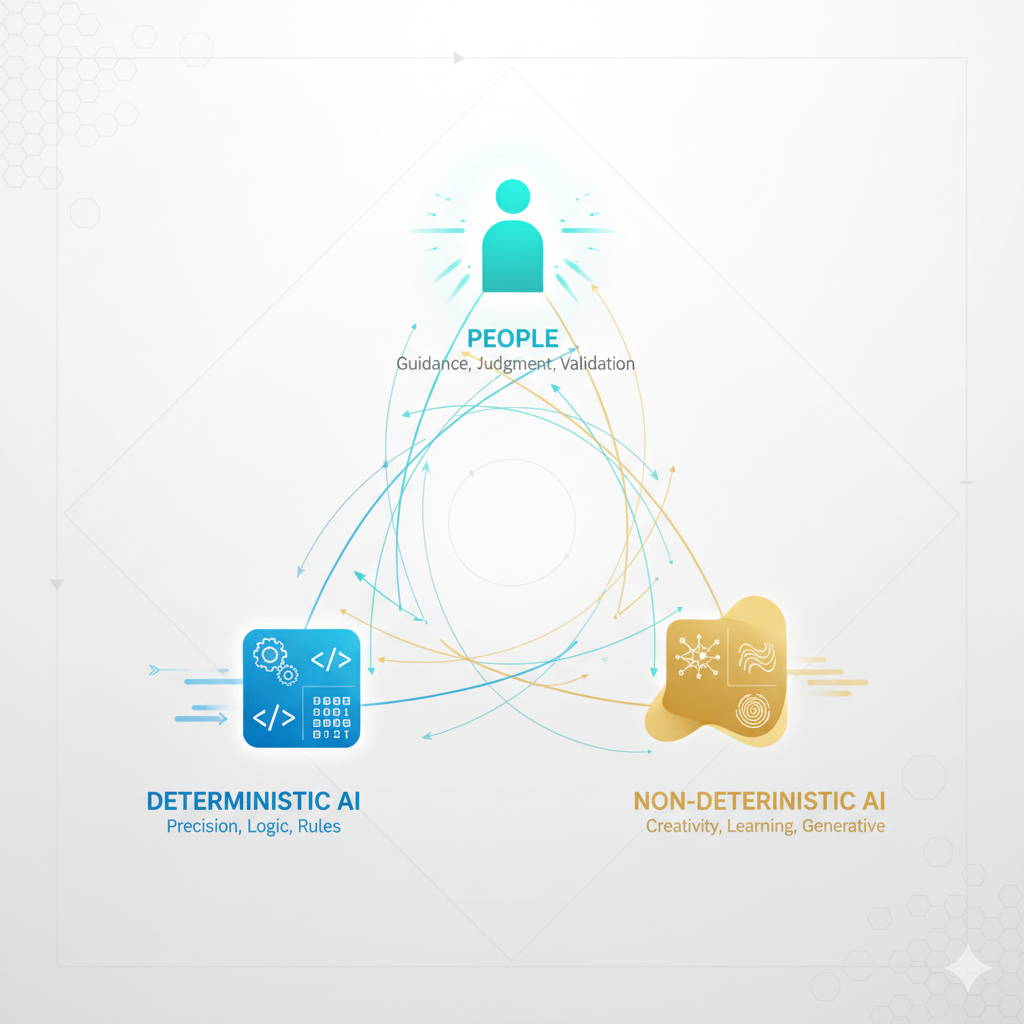
The Triangle of Capability (Made with GenAI)
When these three forces work together, the organization executes work and builds capability at the same time. Deterministic systems ensure reliability and scale. Non-deterministic systems introduce adaptability and insight. People provide purpose and oversight, keeping both aligned to mission and values. This triangle creates balance. It ensures automation does not erase accountability and creativity does not override control.
The result is a human-centered system that integrates precision and imagination, scaling what works while continuously learning what could work better.
Step 3: Upskill for Collaboration, Not Compliance
Technology doesn’t replace critical thinking. It demands more of it. GenAI works best when people know how to work with it. That means helping teams understand what the tool can do, where it adds value, and how to validate its output. This is not about teaching prompts; it is about building confidence and curiosity. Upskilling the workforce is now a business imperative. Encourage employees to question, test, and iterate. Critical thinking turns GenAI from a novelty into a collaborator.
When teams see that AI amplifies rather than replaces their expertise, adoption accelerates. People begin to connect their individual contributions to the organization’s larger outcomes improving both productivity and trust.
Step 4: Measure What Matters in a Two-Way World
We are no longer giving commands to systems; we are having conversations with them. Traditional technology followed a one-way path; we input, it outputs. GenAI changes that. It is now a dialogue between human intent and machine intelligence.
Organizations must redefine what productivity means in this new relationship. Internally, that may look like reduced cycle times, faster insights, and higher-quality deliverables. Externally, it may mean better customer experiences, stronger sales, and greater innovation.
These outcomes ultimately align with two macro goals: growth and efficiency. Growth through improved products, services, and responsiveness. Efficiency through reduced rework, smarter resource use, and clearer decision-making.
The organizations measuring both will see GenAI’s true value unfold.
Step 5: Build, Measure, Learn, Rebuild, Scale
Adoption is not an event. It is an ecosystem. GenAI maturity grows through iteration. The most effective organizations establish learning loops (e.g. build, measure, learn, rebuild, scale) embedding reflection and refinement into every cycle.
Governance and experimentation must coexist. Each new use case becomes an opportunity to update the BBoK, refine the 5Ps, and strengthen alignment between people and platforms.
When adoption becomes a continuous learning system, transformation no longer depends on big launches or rigid milestones. It becomes a living process adapting as fast as the world around it.
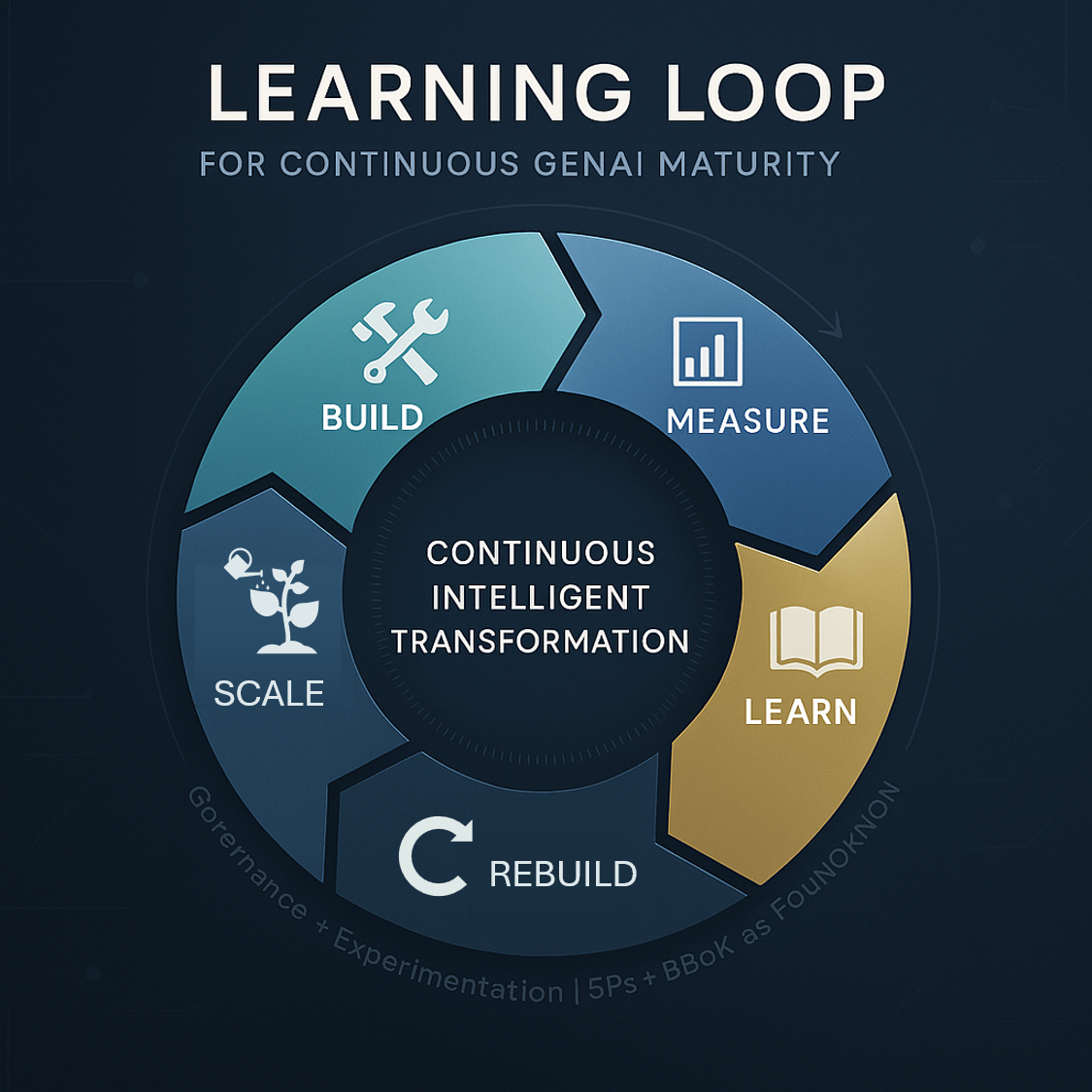
The Learning Loop (Made with GenAI)
From Adoption to Advantage
Every organization is somewhere along this journey. Some are still experimenting. Others are scaling what works. The difference between the two isn’t budget or technology. It is structure, intention, and the discipline to learn.
GenAI doesn’t replace human intelligence; it extends it. The organizations learning how to combine both will not just move faster. They will move smarter.
Remember | Start small. Map what matters. Build your knowledge before your automation.
That is how adoption becomes advantage.
