
Mapping Decision Capability: Where Does Your Agency Stand?
BLUF | Federal agencies are racing to adopt AI, but most lack the decision capability to use it effectively. The Decision Capability Matrix reveals where organizations actually stand, and why technology alone is not enough.
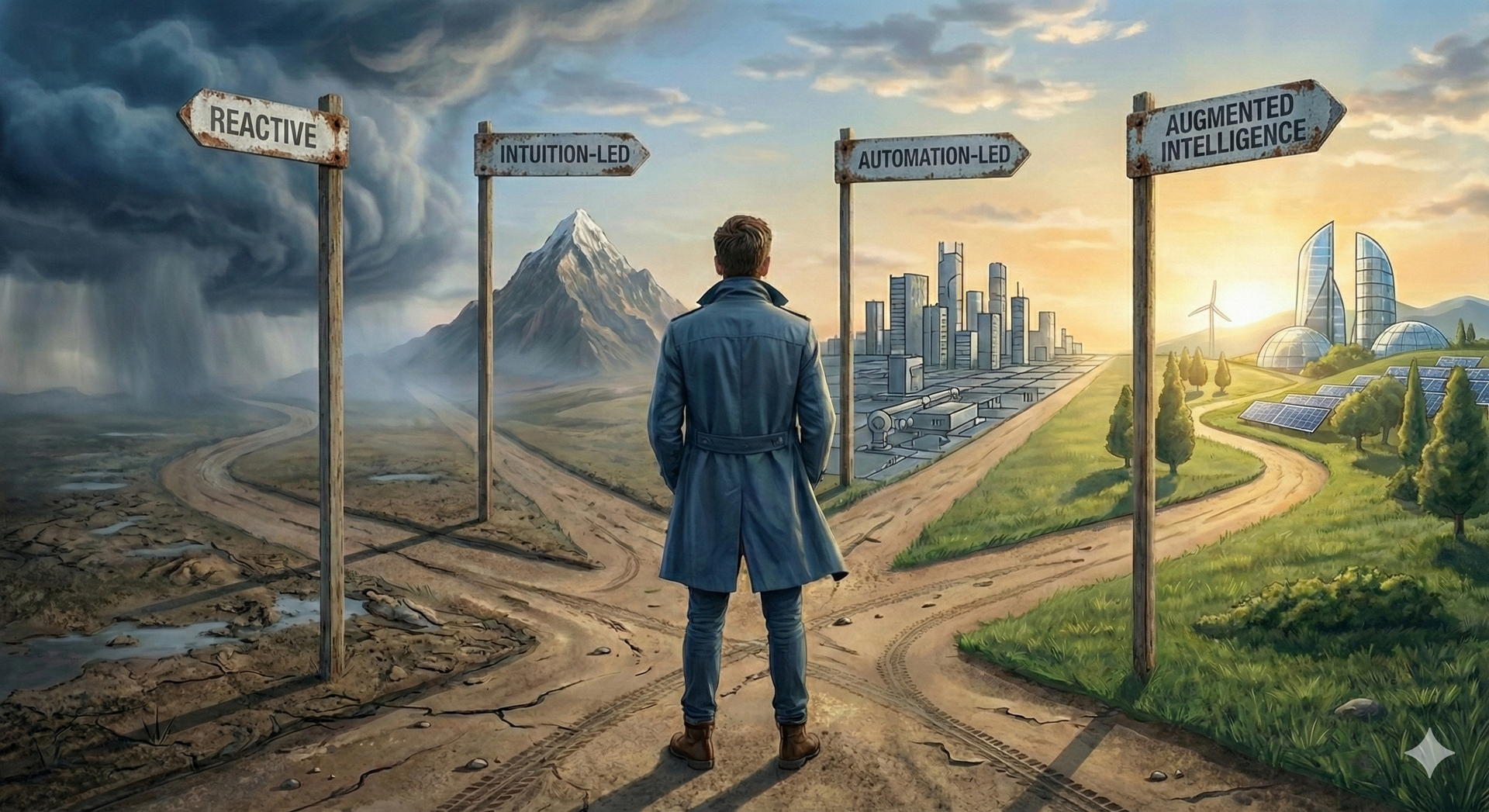
What Path are you choosing when making decisions? (Image by J Eselgroth w/GenAI)
The Landscape Has Shifted
Federal AI policy has pivoted sharply. Executive Order 14179, signed in January 2025, established a national policy of American AI "dominance" and revoked prior AI directives. OMB Memorandum M-25-21 replaced earlier guidance with a framework emphasizing innovation, streamlined governance, and reduced compliance burden. M-26-04 added requirements for "truth-seeking" and "ideological neutrality" in federal AI procurement.
The policy intent is clear: accelerate AI adoption, remove barriers, and favor American-made solutions. Yet acceleration without decision discipline creates new risks. Agencies that deploy AI without clear decision rights, accountability structures, and outcome alignment will struggle to demonstrate the public trust these memoranda require.
The Foundations for Evidence-Based Policymaking Act established the mandate for data-driven government. The current framework establishes the urgency. What remains missing for many agencies is the operational capability to connect AI investments to mission outcomes.
That capability is Decision Intelligence.
Decision Intelligence: The Orchestration Layer
Decision Intelligence is not a technology or a maturity model. As defined by Gartner, it is "a practical discipline that advances decision making by explicitly understanding and engineering how decisions are made and how outcomes are evaluated, managed, and improved via feedback." Dr. Lorien Pratt, a pioneer in this field, frames Decision Intelligence as the action-to-outcome mechanics connecting data, technology, and human insight.
This is no longer an emerging concept. In January 2026, Gartner published its first Magic Quadrant for Decision Intelligence Platforms, marking the transition from emerging technology to a recognized market category. As David Pidsley, Gartner's Decision Intelligence Leader, noted: organizations are moving beyond the "data-driven" dogma toward a genuinely "decision-centric" vision for operations.
Rita Sallam, Gartner's Distinguished VP Analyst and Chief of Research for Data and Analytics, captures the challenge precisely: "Data and analytics leaders aren't short of insight—they're short of control over how insight turns into action. As AI scales, the real challenge is no longer producing better analysis, but governing, measuring, and improving the decisions that analysis feeds."
In the context of AI orchestration, Decision Intelligence serves as the glue that holds everything together. It addresses the human element, what I call the "squishy things" like subjectivity and intuition, that are often overlooked in AI implementations. When faced with finding a needle in a haystack, Decision Intelligence helps us "burn the hay", eliminating irrelevant data and focusing efforts on the most valuable information.
Decision Intelligence operates at the intersection of data science, behavioral science, and organizational design. It answers questions that data alone cannot: Who has authority to decide? What information is required? What are the consequences of being wrong? How fast must we move? What feedback loops exist to improve over time?
Without Decision Intelligence, organizations collect data but do not use it to its fullest potential. They build models but don’t completely trust them. They create dashboards that are rarely checked. Decision Intelligence is the discipline that closes the gap between information and action.
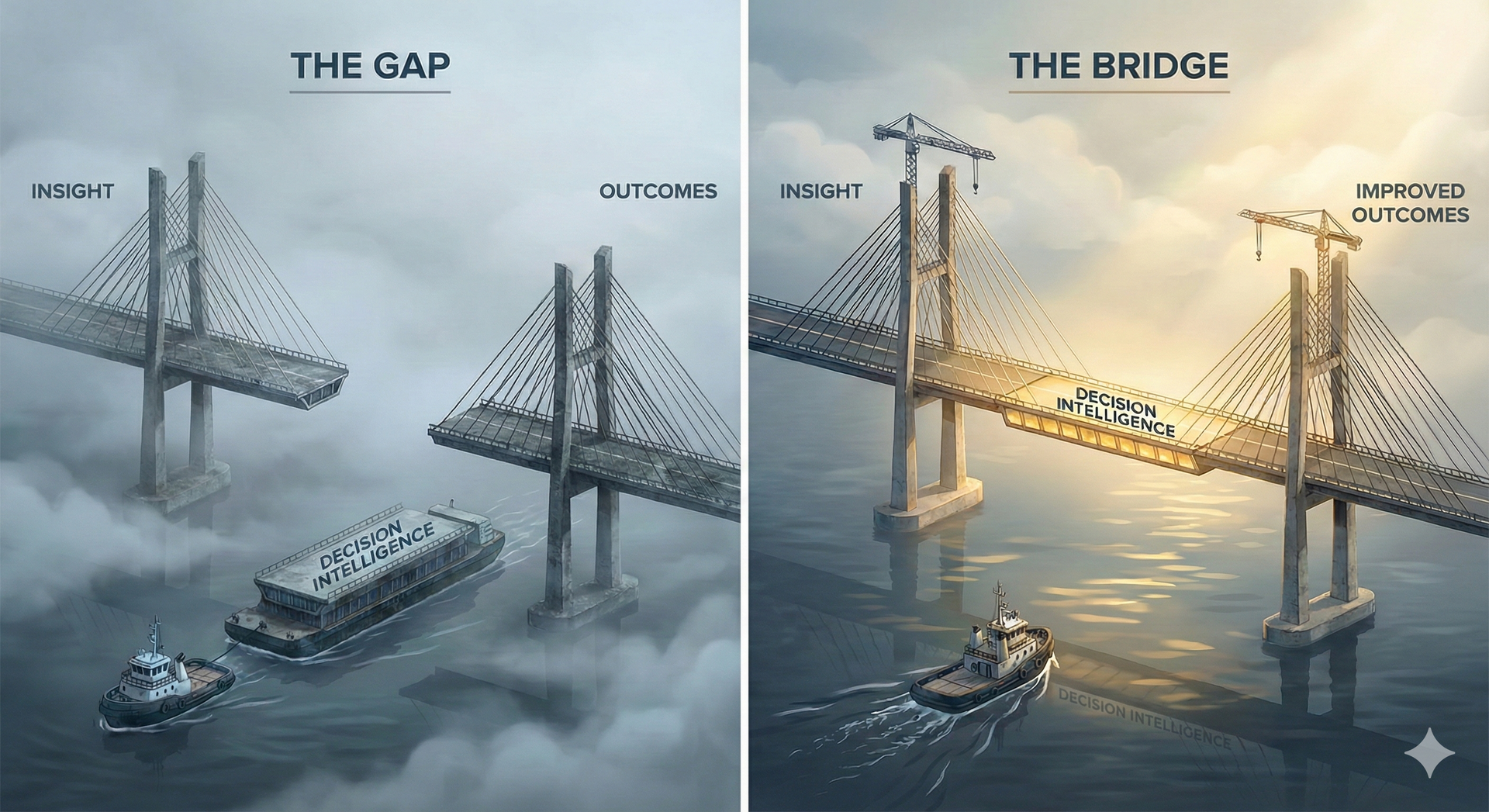
Decision Intelligence is the bridge to improved outcomes (made by J Eselgroth & GenAI)
The Decision Capability Matrix
Federal leaders make decisions based on information from two sources: human judgment shaped by experience, expertise, and context; and machine intelligence shaped by data, algorithms, and computational power. The relationship between these sources determines an organization's decision-making capability.
This can be mapped across two dimensions. The first is Human Governance: the extent to which human judgment, accountability structures, ethics, and guardrails guide decisions. The second is AI Capability: the extent to which artificial intelligence, including automation, prediction, generation, and autonomous systems, supports or executes decisions.
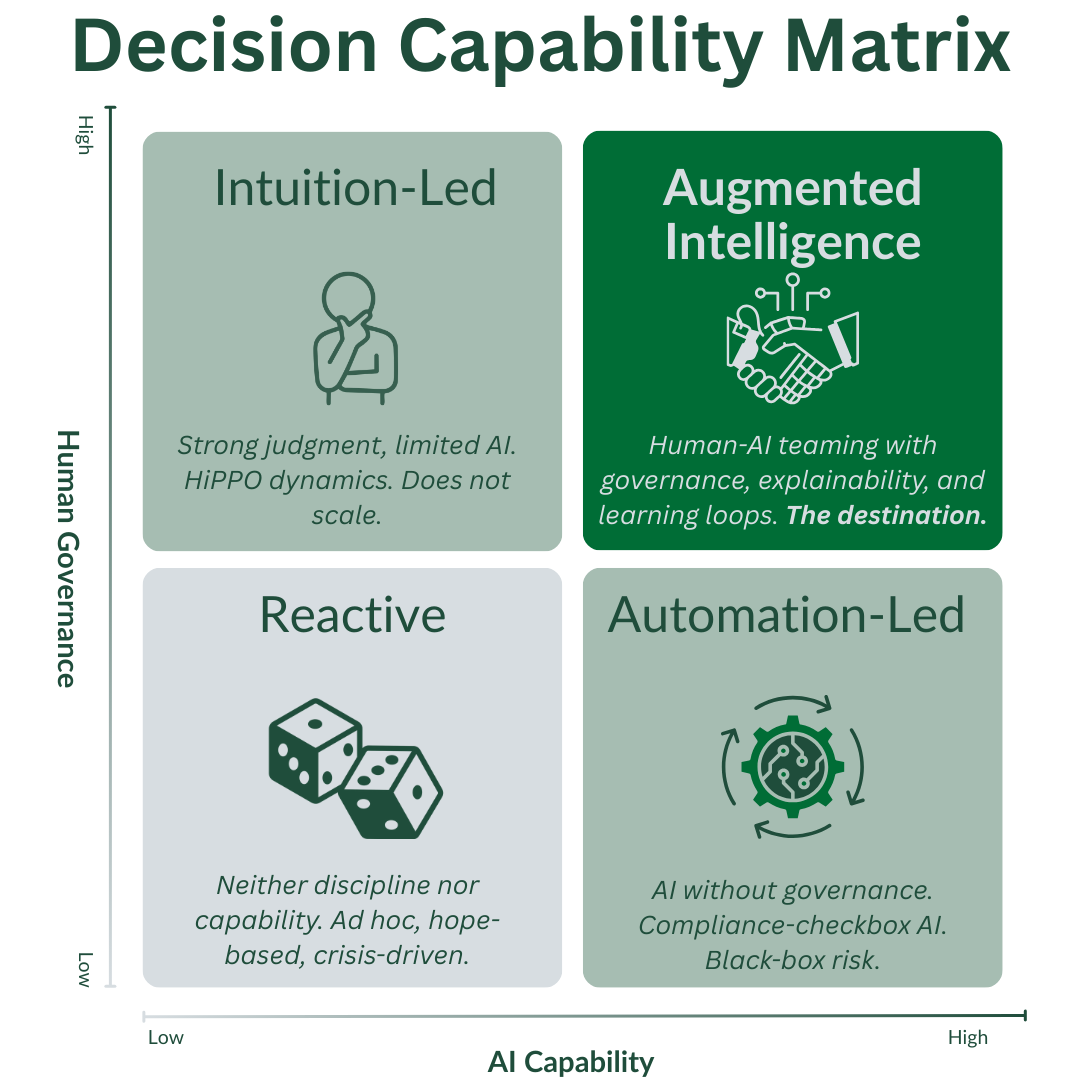
The Decision Capability Matrix (Image by J Eselgroth)
Understanding the Quadrants
Reactive (Low Human Governance, Low AI Capability)
Organizations in this quadrant operate on hope. Decisions are ad hoc, crisis-driven, or simply not made. Without focus from either human leadership or machine intelligence, outcomes depend on luck. Leaders face budget overruns, costly rework, and cycles wasted on irrelevant tasks. Disagreements about priorities consume more energy than execution.
Some agencies have also arrived here through a different path: they purchased AI tools without governance frameworks. They have capability without direction.
Random acts of AI produce random results.
Intuition-Led (High Human Governance, Low AI Capability)
These organizations have built something valuable: clear accountability, strong professional judgment, and leaders whose experience has guided sound decisions for years. This is not a weakness. It is a foundation.
The opportunity is scale. Human attention is finite. When every significant decision flows through senior leaders, the organization cannot move faster than its most experienced people can think. This is not a criticism of those leaders. It is a recognition that their expertise is a bottleneck precisely because it is so trusted.
Organizations cannot move faster than its most experienced people can think
Many leaders in these organizations approach AI with healthy skepticism. They have seen technology fail before. They have watched implementations promise transformation and deliver disruption. That skepticism is earned. It also reflects something important: these leaders understand that decisions carry consequences, and they take that responsibility seriously.
The path forward is not to replace that judgment. It is to amplify it. Augmented Intelligence extends the reach of experienced leaders, allowing their expertise to inform more decisions, faster, without sacrificing the governance that makes those decisions trustworthy.
Automation-Led (Low Human Governance, High AI Capability)
Here organizations have invested heavily in AI and automation. Dashboards proliferate. Models run. But governance has not kept pace. Decisions emerge from black boxes. Accountability is unclear. When the algorithm is wrong, no one knows why or how to fix it.
This quadrant creates compliance risk. M-25-21 requires AI governance boards, risk management for high-impact AI, and documented AI strategies. M-26-04 mandates vendor documentation through model and system cards. Organizations that cannot demonstrate accountability and transparency will face increasing scrutiny. Checkbox AI, where tools are deployed to satisfy mandates rather than improve decisions, lives here.
The stakes are quantifiable. Gartner predicts that by 2027, 25% of ungoverned decisions using large language models will cause financial or reputational loss due to human biases, insufficient critical thinking, and AI sycophancy.
Governance is not optional.
Augmented Intelligence (High Human Governance, High AI Capability)
The upper-right quadrant represents the destination. Human judgment and machine intelligence work together within clear governance structures. Leaders set intent and guardrails. AI handles pattern recognition, prediction, and routine decisions. Humans handle exceptions, ethics, and strategy.
This is not about humans versus machines. It is about humans with machines. The combination outperforms either alone. Research consistently shows that human-AI teams achieve better outcomes than pure automation or pure human judgment. The key is proper integration, and Decision Intelligence provides the orchestration layer that makes integration work.
It is about humans with machines. The combination outperforms either alone.
What Comes Next
Knowing where you stand is the first step. The Decision Capability Matrix provides the diagnostic. But diagnosis without treatment is incomplete.
In the next article, From Reactive to Augmented: Building Decision Capability, we explore how to move from any quadrant toward Augmented Intelligence. The journey requires both a solid digital foundation, what I call the 5Ps, and a deliberate transformation method, the 5Cs of Intelligent Transformation.
The question is not whether your agency will pursue AI. The question is whether you will build the decision capability to make AI work.
References
- Gartner Glossary: Decision Intelligence. https://www.gartner.com/en/information-technology/glossary/decision-intelligence
- Pidsley, D. (2026). Decision Intelligence Platforms. Gartner Magic Quadrant. https://www.linkedin.com/pulse/decision-intelligence-platforms-david-pidsley-gelne/
- Eselgroth, J. (2025). Decision Intelligence: The Missing Piece in AI Orchestration? Chiron AI. https://www.chironai.io/decision-intelligence-the-missing-piece-in-ai-orchestration
