
From Reactive to Augmented: Building Decision Capability
BLUF | The Decision Capability Matrix shows where you stand. This article shows how to move. The 5Ps provide the foundation. The 5Cs of Intelligent Transformation provide the path to Augmented Intelligence.
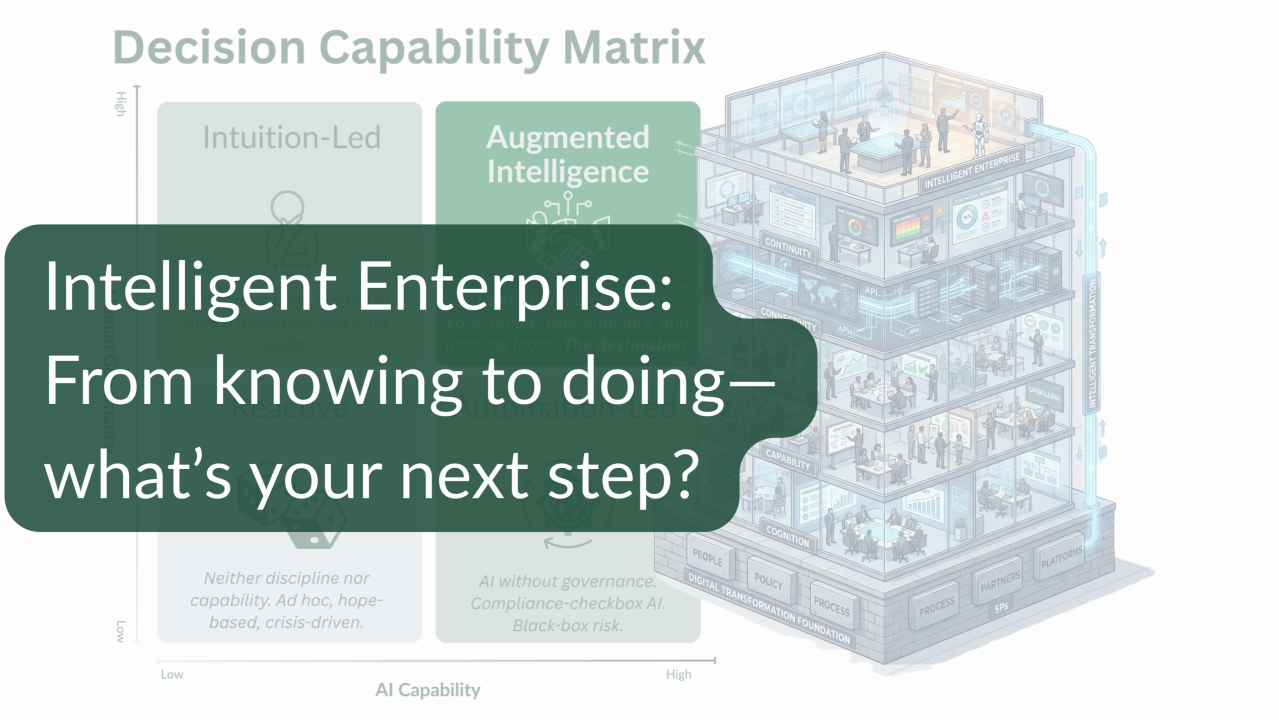
From Diagnosis to Action
In the previous article, Mapping Decision Capability: Where Does Your Agency Stand?, we introduced the Decision Capability Matrix. The matrix plots organizations across two dimensions: Human Governance and AI Capability. Most federal agencies find themselves in one of three suboptimal quadrants: Reactive, Intuition-Led, or Automation-Led.
The destination is the upper-right quadrant: Augmented Intelligence. This is where human judgment and machine intelligence work together within clear governance structures. But knowing the destination is not the same as knowing how to get there.
The journey requires two things: a solid foundation and a deliberate transformation method.
The Foundation: 5Ps of Digital Transformation
Before organizations can pursue Intelligent Transformation, they need a solid digital foundation. This is where the 5Ps come in. The 5Ps, People, Policy, Process, Partners, and Platforms, represent the essential infrastructure for any digital initiative.
- The 5P | Digital Transformation Foundation
- People | Skills, roles, change management, and workforce readiness
- Policy | Governance, compliance, security, and decision rights
- Process | Workflows, automation candidates, and operational efficiency
- Partners | Internal collaboration and external expertise
- Platforms | Technology infrastructure, data systems, and integration
Organizations that neglect the 5Ps will struggle to advance. If your platforms cannot integrate data, your AI investments will underperform. If your policies do not address AI governance, you will face compliance gaps. If your people lack the skills to work with AI, adoption will stall. The 5Ps are not optional. They are the prerequisite.
However, the 5Ps alone are not sufficient to reach Augmented Intelligence. They establish the foundation for digital transformation, but the journey to Intelligent Transformation requires something more.
The Path Forward: 5Cs of Intelligent Transformation
The 5Cs build on top of the 5Ps. Where the 5Ps establish digital infrastructure, the 5Cs enable intelligent decision-making. The 5Cs of Intelligent Transformation are:
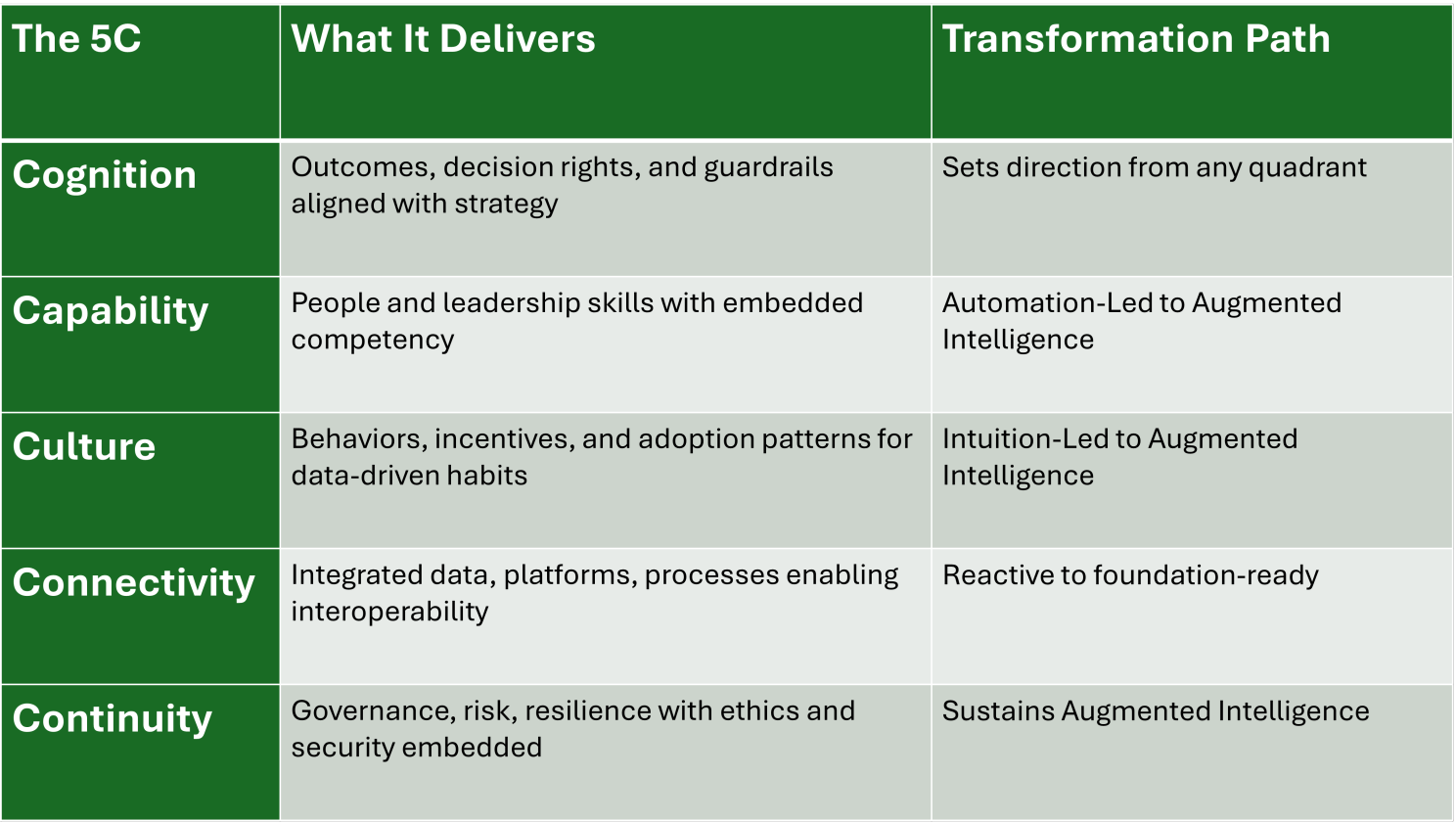
The 5C's Table, the what, and the path (Image by J Eselgroth)
Cognition | Cognition establishes clarity about what the organization is trying to achieve and how decisions will be made. It defines outcomes, decision rights, and guardrails. It aligns AI capabilities with strategic objectives. Without cognition, organizations deploy technology without purpose.

The building blocks of an Intelligent Enterprise from 5Ps through the 5Cs (Image by J Eselgroth with GenAI)
Capability | Capability builds the human skills required to work with AI effectively. This is not just technical training. Leaders must understand how to set intent, interpret outputs, and override when necessary. The workforce must develop judgment about when to trust machine recommendations and when to question them.
Culture | Culture shapes the behaviors and incentives that make data-driven decision making stick. Technology adoption fails when it conflicts with how people are rewarded. Culture change requires visible leadership commitment, aligned incentives, and patience. It is the hardest C to change and the most important to sustain.
Connectivity | Connectivity integrates data sources, platforms, processes, and workflows. Interoperability enables automation. Connected systems allow insights to flow to where decisions happen. Without connectivity, intelligence stays trapped in silos.
Continuity | Continuity establishes the governance, risk management, and resilience structures that sustain progress. It embeds ethics, security, and continuous improvement into decision processes. Without continuity, organizations backslide. Early gains erode. The effort hump reappears.
Gartner's recent Magic Quadrant for Decision Intelligence Platforms reinforces continuity as essential. Carlie Idoine, Vice President Analyst at Gartner, states: "Global competition, geopolitical disruptions, and growing customer demands are putting unprecedented pressure on organizations to clarify and accelerate their decision making. Enterprises can no longer afford decisions that lack transparency or accountability." Decision stewardship, the practice of governing decisions with the same rigor as data, is what Gartner calls the "big deal" for 2026.
The Benefits of Achieving Augmented Intelligence
Organizations that achieve Augmented Intelligence gain decision advantage. In competitive or adversarial environments, this advantage is existential.
Win-Win Prioritization. When decision-makers have both human judgment and AI-generated insights, prioritization becomes collaborative rather than political. Data surfaces the largest issues. Human judgment weighs context and consequences. Stakeholders align around evidence rather than hierarchy.
Focused Budgeting. Augmented Intelligence makes resource allocation more precise. Leaders can see which investments will generate the greatest mission impact. Subjective arguments give way to informed debates about priorities and trade-offs.
Improved Conflict Resolution. Large initiatives generate disagreements. When challenges arise, Augmented Intelligence helps decision-makers focus on the situation rather than the personalities. Being more objective and less subjective helps teams understand issues, evaluate options, and anticipate consequences.
Decision Advantage and the OODA Loop. Most importantly, organizations with Augmented Intelligence complete the OODA loop, Observe, Orient, Decide, Act, faster than competitors or adversaries can reach their second O. This is the speed of relevance. Clearer understanding of second, third, and fourth-order effects improves decision quality. Faster cycle time improves decision speed. The combination delivers decision advantage: better decisions, made faster, with greater confidence in outcomes.
Gartner quantifies this advantage. They predict that by 2030, explicitly modeled business decisions will be five times more trusted and 80% faster than ungoverned decisions. This reflects what happens when organizations move from opaque recommendation engines to transparent, governed decision architectures. The benefits compound: trust enables adoption, adoption enables scale, scale enables impact.
From Matrix to Mission
The Decision Capability Matrix (Below) shows where an organization stands. The 5Cs show how to move. But movement requires context about where the organization is going.
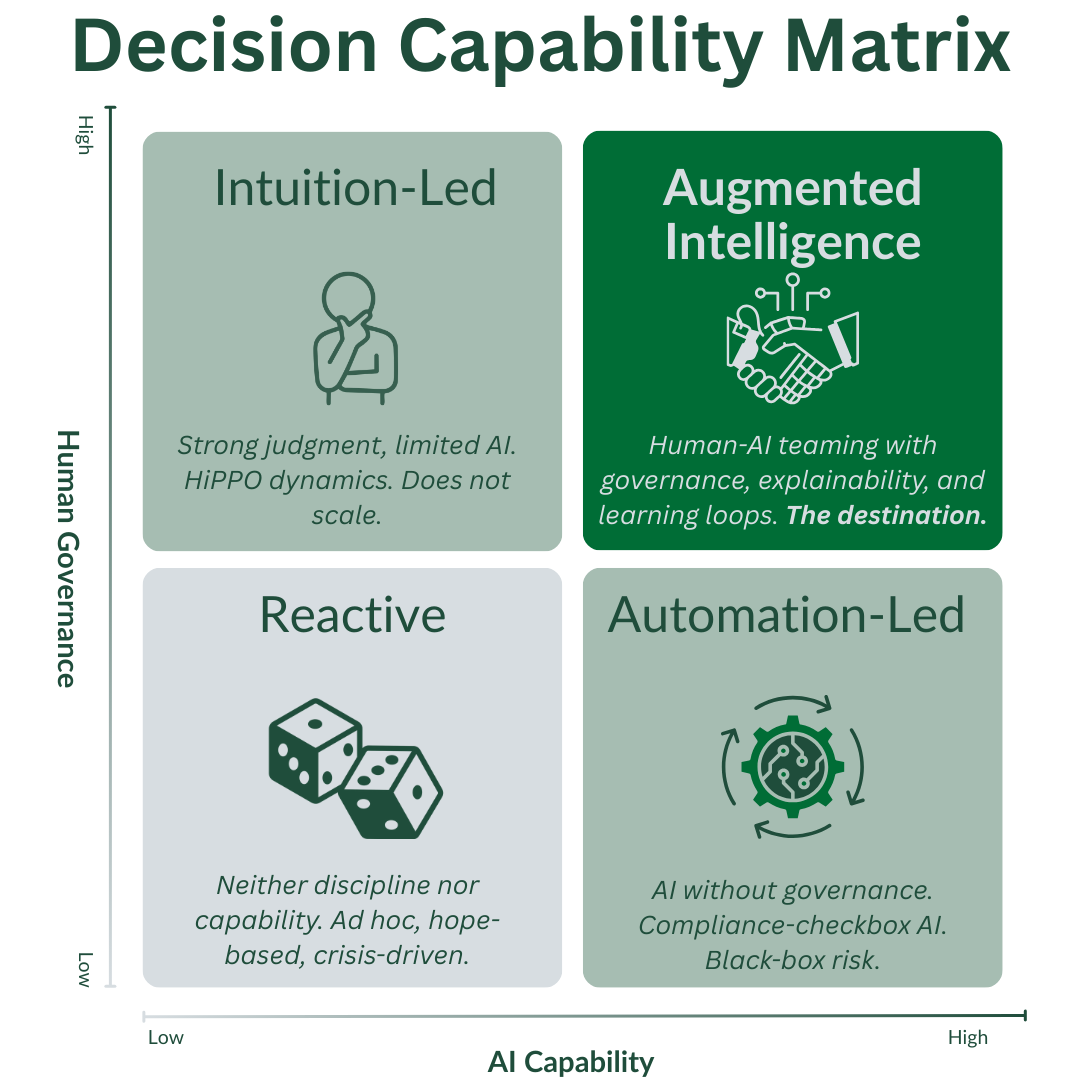
The Decision Capability Matrix, achieving Augmented Intelligence (Image by J Eselgroth)
The Digital Efficiency Matrix (Below) provides that context. It maps organizational maturity across efficiency and digital capability, from Laggards through Implementers to Leaders. Augmented Intelligence is what Leaders do. It is the decision-making capability that distinguishes organizations at the top of the maturity curve.
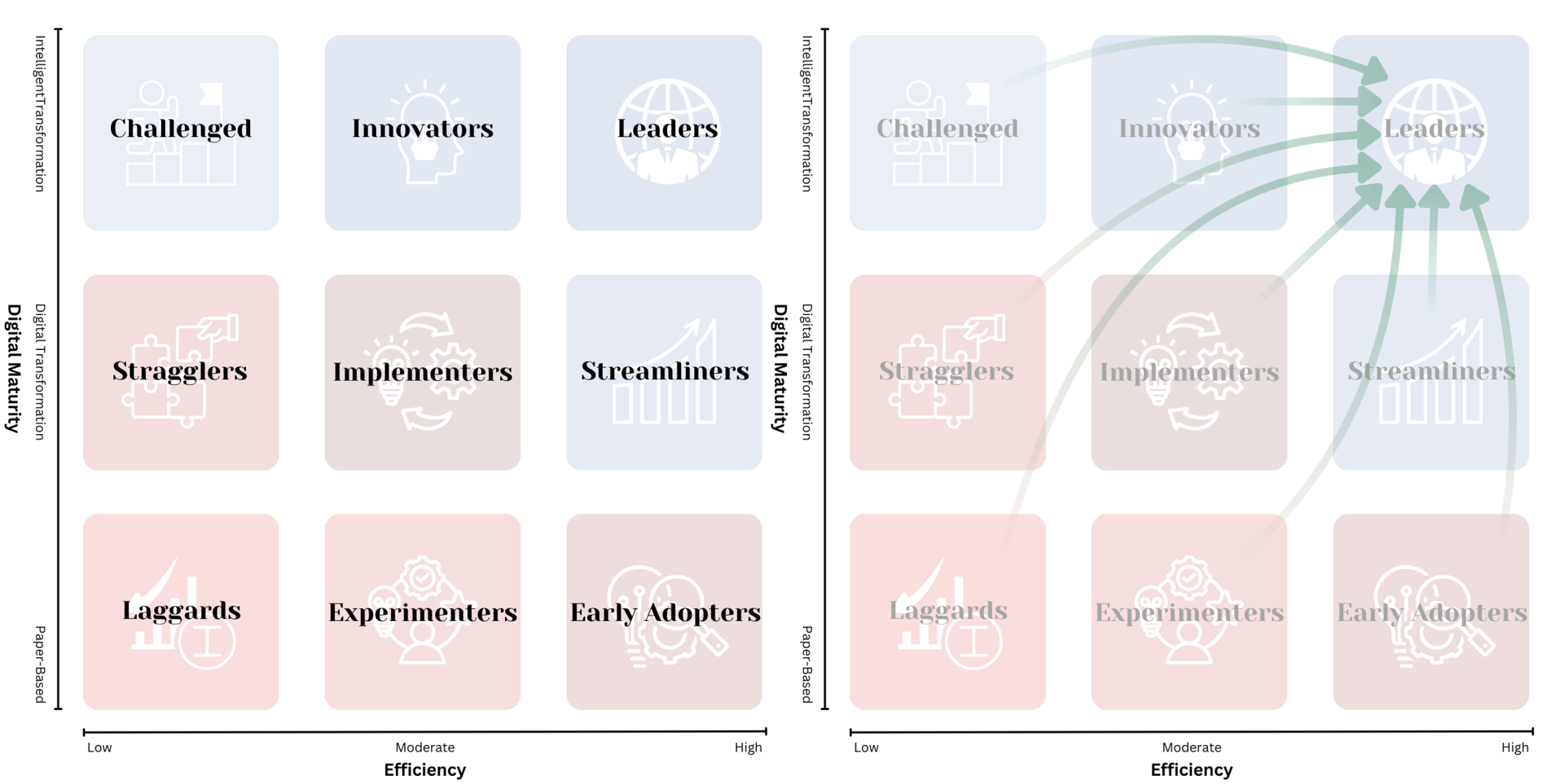
The Digital Efficiency Matrix from Laggards to Leaders of the Intelligent Enterprise (Image by J Eselgroth)
The destination is the Intelligent Enterprise: an organization where intelligence, both human and artificial, is embedded in every process, decision, and interaction. Decision Intelligence provides the orchestration. The 5Cs provide the method. Augmented Intelligence provides the capability.
The Path Forward
The current policy environment demands action. EO 14179 and M-25-21 push agencies to accelerate AI adoption. M-25-22 shapes how agencies acquire AI. M-26-04 sets expectations for transparency and accountability. The pressure to move fast is real.
But speed without direction is dangerous. Agencies that deploy AI without Decision Intelligence will struggle to demonstrate the public trust these policies require. They will accumulate tools without outcomes. They will automate processes without improving decisions.
Agencies that deploy AI without Decision Intelligence will struggle to demonstrate the public trust these policies require.
The Decision Capability Matrix provides the map. The 5Cs provide the method. Augmented Intelligence provides the destination. Digital transformation was the beginning. Intelligent Transformation is the bridge. The Intelligent Enterprise is where we are headed.
The agencies that build this capability will lead. The agencies that do not will struggle to keep pace with a world that moves faster every day. The choice is not whether to pursue Augmented Intelligence. The choice is whether to pursue it deliberately or stumble toward it haphazardly.
The 5Cs offer a deliberate path.
References
- Eselgroth, J. (2026). Mapping Decision Capability: Where Does Your Agency Stand? Chiron AI.
- Pidsley, D. (2026). Decision Intelligence Platforms. Gartner Magic Quadrant.
- Eselgroth, J. (2025). The Unending Quest for Efficiency: Navigating Beyond Digital Transformation. Chiron AI. https://www.chironai.io/the-unending-quest-for-efficiency-navigating-beyond-digital-transformation
- Eselgroth, J. (2025). Delivering Tailorability to the Tactical Level in the Age of AI. Chiron AI. https://www.chironai.io/delivering-tailorability-to-the-tactical-level-in-the-age-of-ai
- Eselgroth, J. (2025). Decision Intelligence: The Missing Piece in AI Orchestration? Chiron AI. https://www.chironai.io/decision-intelligence-the-missing-piece-in-ai-orchestration
